Small and Medium Expectations, Plata o Plomo
Andrei Huțuleac’s Great Expectations at Teatrul Excelsior keeps Dickens in his own century and fits a whole town into eight actors. What it uncovers is the book’s real subject: shame.
There is an irony Dickens did not plan, and I don’t think he would even have enjoyed it, but it sits at the heart of the book, right there, like a needle in a velvet cushion: Great Expectations, the novel about a boy whose future someone else decides without asking him, is itself a novel whose ending someone else decided without asking its author very much. Dickens wrote an ending, showed it to a friend, the friend turned up his nose, and Dickens went home and wrote another, gentler, brighter, more saleable. Pip receives a fortune from a convict and believes it comes from a senile old lady, just as the reader receives a happy ending and believes it comes from Dickens.
I walked out of the Saturday evening preview (5 September 2026) in the Ion Lucian hall with that question in my head, because the production staged by Andrei Huțuleac asks it, even if it never puts it into words: how much of what we want for ourselves did we order ourselves, and how much was delivered to our door by someone we cannot see?
A novel written in a rush, to save a magazine
Beyond history romanticised as a blend of theme, time and nostalgia, Great Expectations is a novel of commercial emergency. At the end of 1860, Dickens’s magazine, All the Year Round, was slowly sinking under the weight of a serial by Charles Lever, A Day’s Ride, which the public had abandoned with devastating elegance: they simply stopped buying it. Dickens, who was at once author, editor, owner and businessman (a combination that deserves a study of its own, because it explains half of Victorian literature), did the only thing he knew how to do: he took over the writing himself.
And he wrote it weekly, not monthly as was his habit. The difference sounds technical, but it is huge. The monthly instalment let Dickens breathe, sprawl, open five parallel plots and tie them up in the last three numbers. The weekly instalment forgives nothing. Which is how Dickens’s most tightly built novel, his leanest, the closest to a play in its economy of means, was born out of a subscription crisis. (What I see here: the masterpiece as a cash-flow accident. Those who complain today that the algorithm ruins art should remember that art has always been made with one eye on the print run, only back then the print run went by another name, and what we are left with is an analogue soft spot for the pre-Media-eval way of doing things.)
Great Expectations is Dickens’s second novel written in the first person, after David Copperfield, and we have known since Forster that before starting it he reread Copperfield so as not to repeat himself. It is the gesture of a mature author, and a slightly frightened one, who knows his habits and guards against them. The result is a narrative voice with none of David’s autobiographical tenderness: the Pip who tells the story does not love the Pip in it. He watches him, judges him, sometimes politely despises him. The whole book is an adult rereading his adolescence and shrinking with shame.
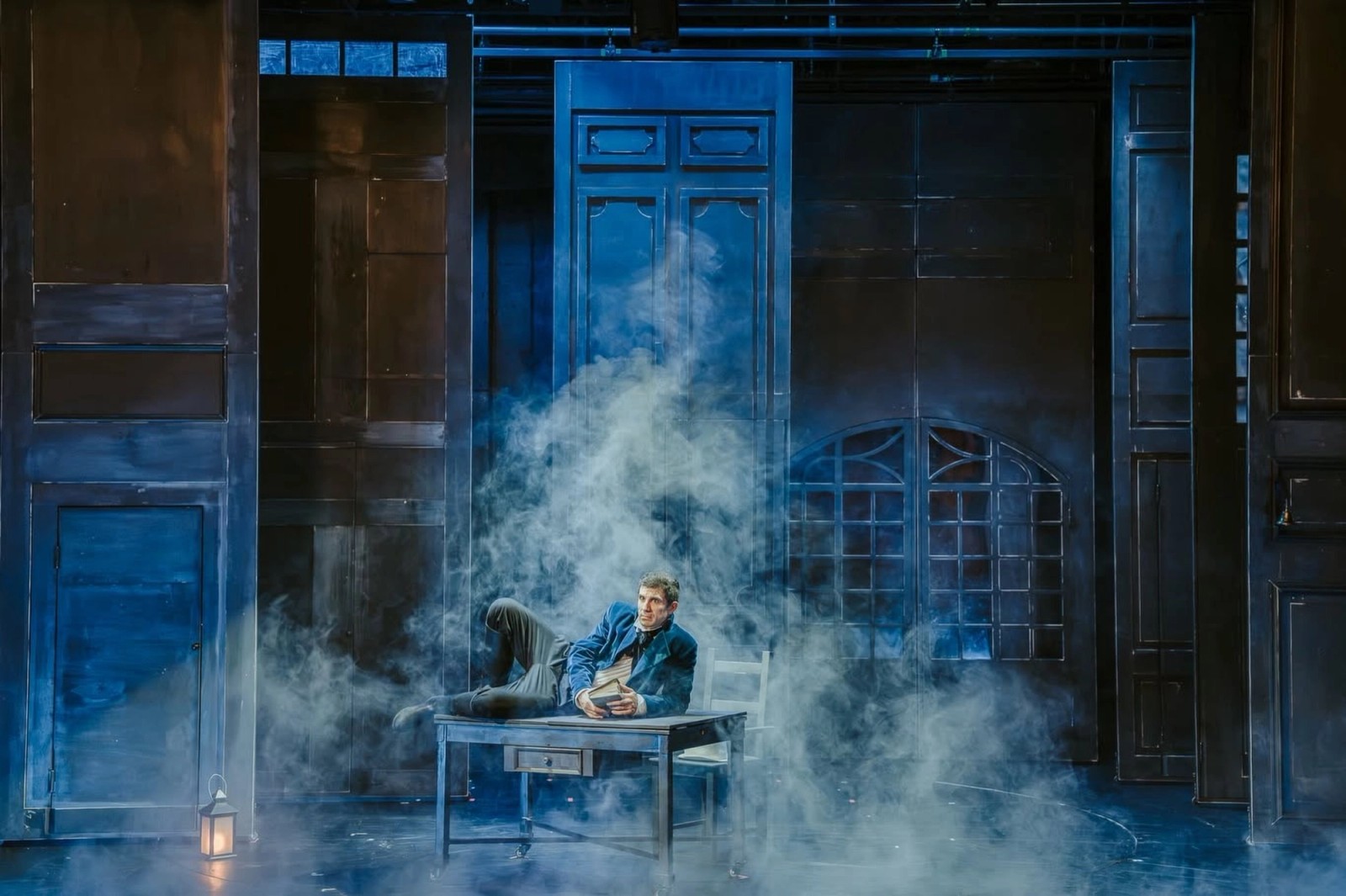
“Shame” is also the key word of the whole production at Teatrul Excelsior.
In the summer of 1861, with the novel almost finished, Dickens gave the proofs to Edward Bulwer-Lytton. Bulwer-Lytton was a novelist of enormous success and modest posterity, the kind of author literary history keeps mostly as a footnote to someone else’s biography. The ball boy, the facilitator, the benefactor. A man with an instinct he put ahead of ego or credit. He was no fool, though, and he had a direct stake in the magazine, where his own serial was about to appear.
The ending Bulwer-Lytton read went roughly like this: a few years after all the misfortunes, Pip is walking along Piccadilly with Joe and Biddy’s little boy, also christened Pip, and runs into Estella. She has been widowed by Bentley Drummle, has remarried a doctor from Shropshire, and is visibly changed by suffering. She takes the child for Pip’s son. They exchange a few sentences. They part. That’s all. A meeting of a few minutes on a London street: two people who were once the stuff of a great love story, and who are now two polite passers-by.
Bulwer-Lytton found it too harsh. Dickens, who had an almost touching uncertainty about his own endings for a man of his authority, listened to him. He rewrote it. The new ending brings the two of them into the ruined garden of Satis House, in the mist, in the evening, among stones and weeds, and closes on a sentence that in the first edition of 1861 reads “I saw the shadow of no parting from her”, and which Dickens reworked once more for later editions, turning it into “I saw no shadow of another parting from her”. Anyone who believes literature is made of inspiration is invited to reflect on the fact that one of the most famous endings in the English novel was rewritten twice and still stayed ambiguous.
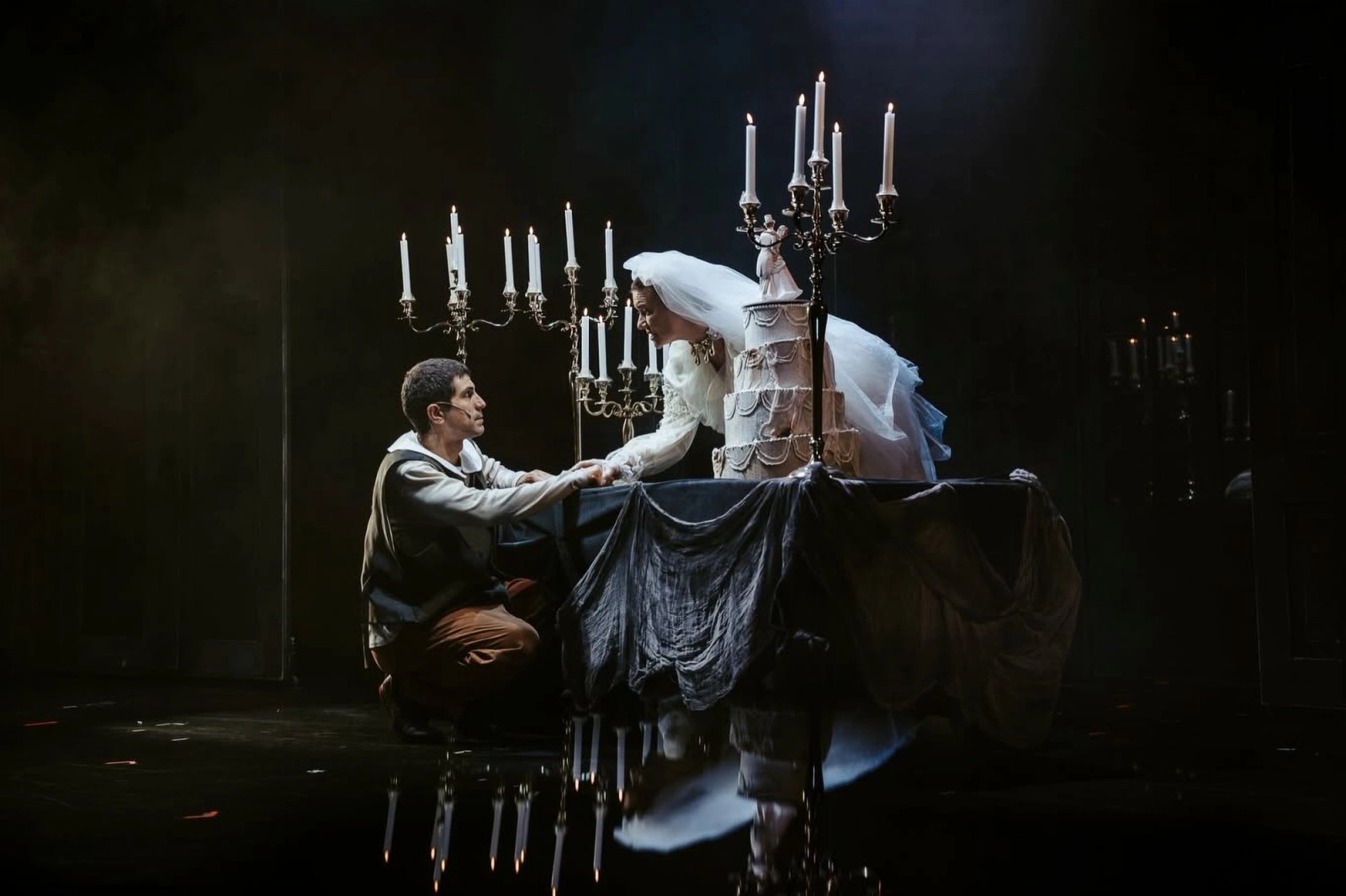
Forster, his friend and biographer, wrote in black and white that he preferred the first version. George Bernard Shaw, who forgave nobody anything, went further: in the edition he prefaced in 1937 he reprinted the original ending, considering the compromise a capitulation. Ever since, almost every serious edition prints both versions, which means this novel has lived for a century and a half with two hearts.
And now comes the part that really interests me. This is not just a bit of literary history to trot out in interviews. The fact that Great Expectations has two endings is a property of the book, not an accident of it. A novel about a man who discovers that his future was bought by someone else ends, literally, with an ending bought by someone else. The form repeats the content and, look, Dickens himself became Pip, as in a self-fulfilling prophecy.
Eight actors, Dickens’s words and nothing else
The version played at the Excelsior is Neil Bartlett’s, in Adrian Nicolae’s translation. Bartlett is an adapter with a method, not an illustrator: he had already done Oliver Twist and A Christmas Carol when he arrived at Great Expectations, at the Bristol Old Vic, in 2013. His rule is simple and hard. Only Dickens’s words are used, cut and reassembled. It is played by eight. The actors solve the rest.
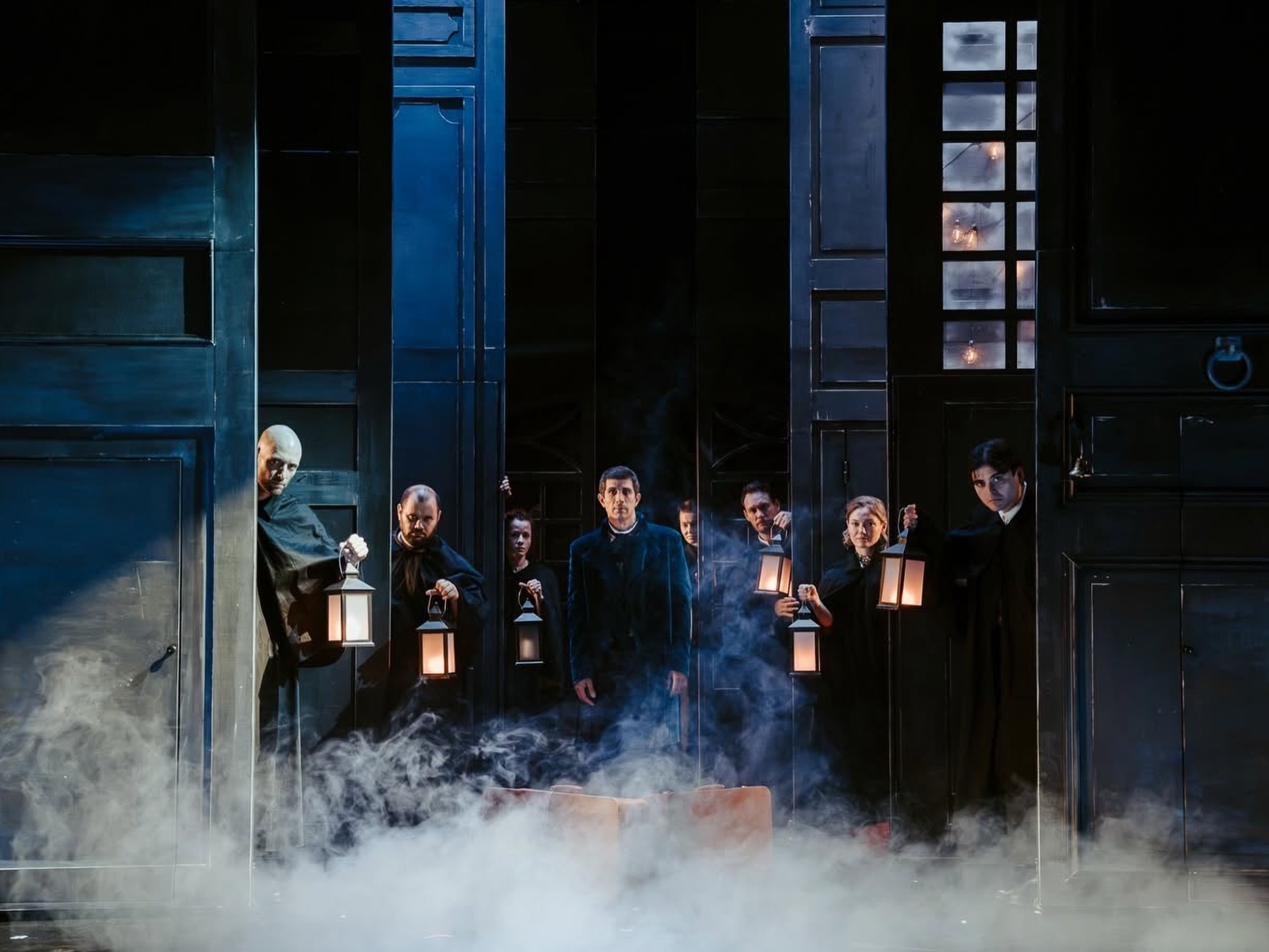
Eight is a number that, applied to a novel with the population of a small town, automatically produces a kind of vertigo, and the Excelsior has kept to it to the letter, by the Lord’s leave (Andrei Huțuleac, director). Alex Călin carries Pip alone, while the other seven multiply. Mihai Mitrea plays Joe Gargery and the lawyer Jaggers (and, so we don’t get too comfortable, because, well..., a chambermaid). Loredana Cosovanu goes through Mrs Joe, Biddy, Wemmick and Camilla Pocket. Matei Arvunescu gathers Pumblechook, Herbert Pocket, Compeyson and Sarah Pocket. Mircea Alexandru Băluță is Magwitch and Mr Wopsle. Camelia Pintilie plays Miss Havisham, Ioana Niculae plays Estella (likewise, like Pip, at every age, with a lovely red thread running through), and Ovidiu Ușvat plays the sergeant, Bentley Drummle and three or so more silhouettes.
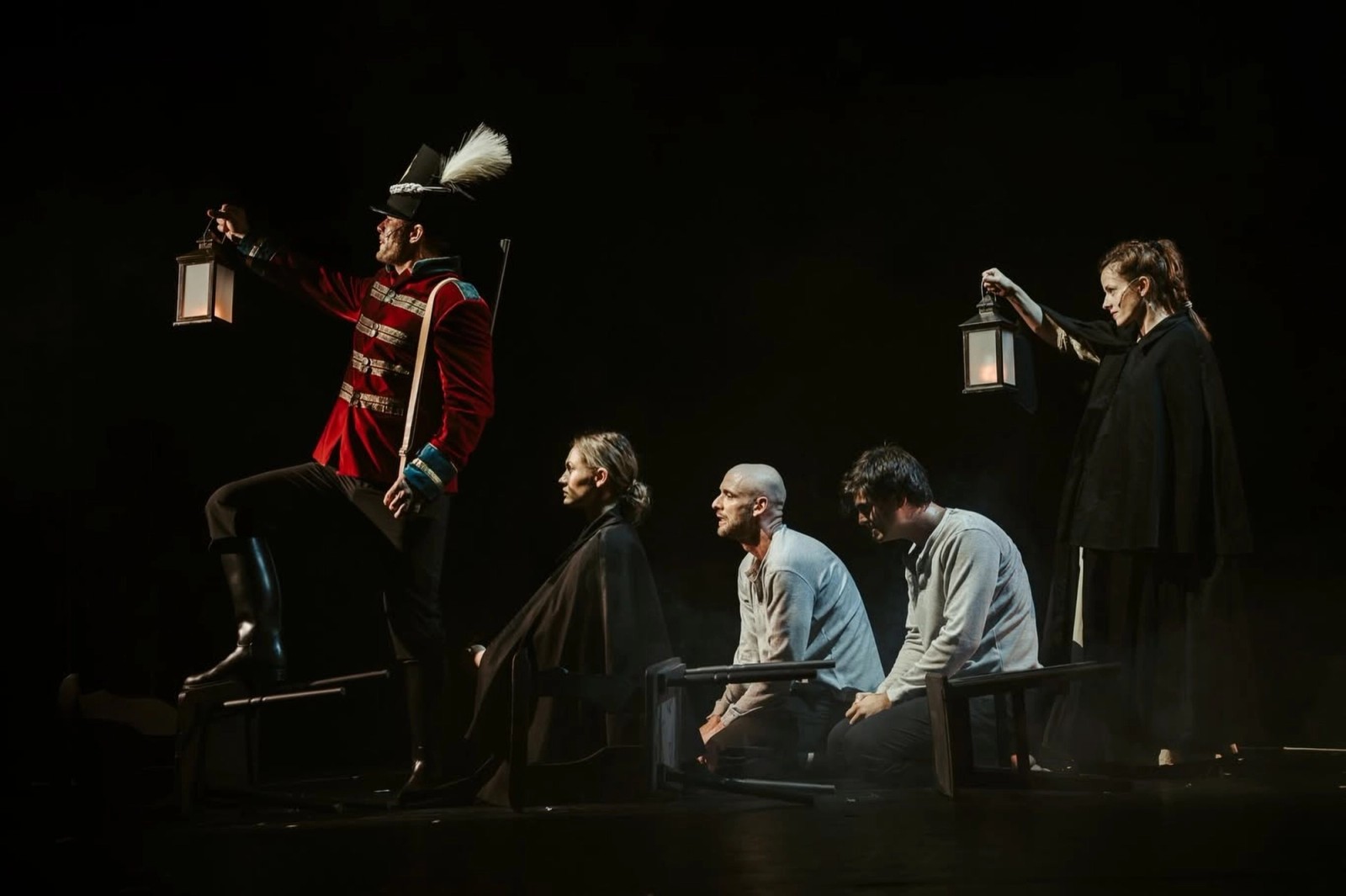
These doublings are not budget savings, they are an argument. The finest is gathering Joe and Jaggers into one body and splitting them with particular delicacy: the blacksmith who loves without conditions and the lawyer who signs nothing without conditions, Pip’s two possible fathers, the two models of manhood the whole book is played out between, played by the same man. Likewise Pumblechook and Compeyson in the same casting: the petty flatterer and the big-time crook, the same disease at two stages. And Mrs Joe with Biddy, the sister who hits and the girl who comforts, both in the same actress, which says more about the house on the marshes than any set ever could.
That all of this can already be seen in the programme, before the lights come up, is the sign of a well-thought-out adaptation. What the direction does with it is another matter. But the device of stepping out of character now and then, as a transition to another diegetic level, deserves a mention. It has the effect of an adult playing peekaboo with a baby from behind their own hands. The audience, here, is the baby. And we eat out of the actors’ hands...
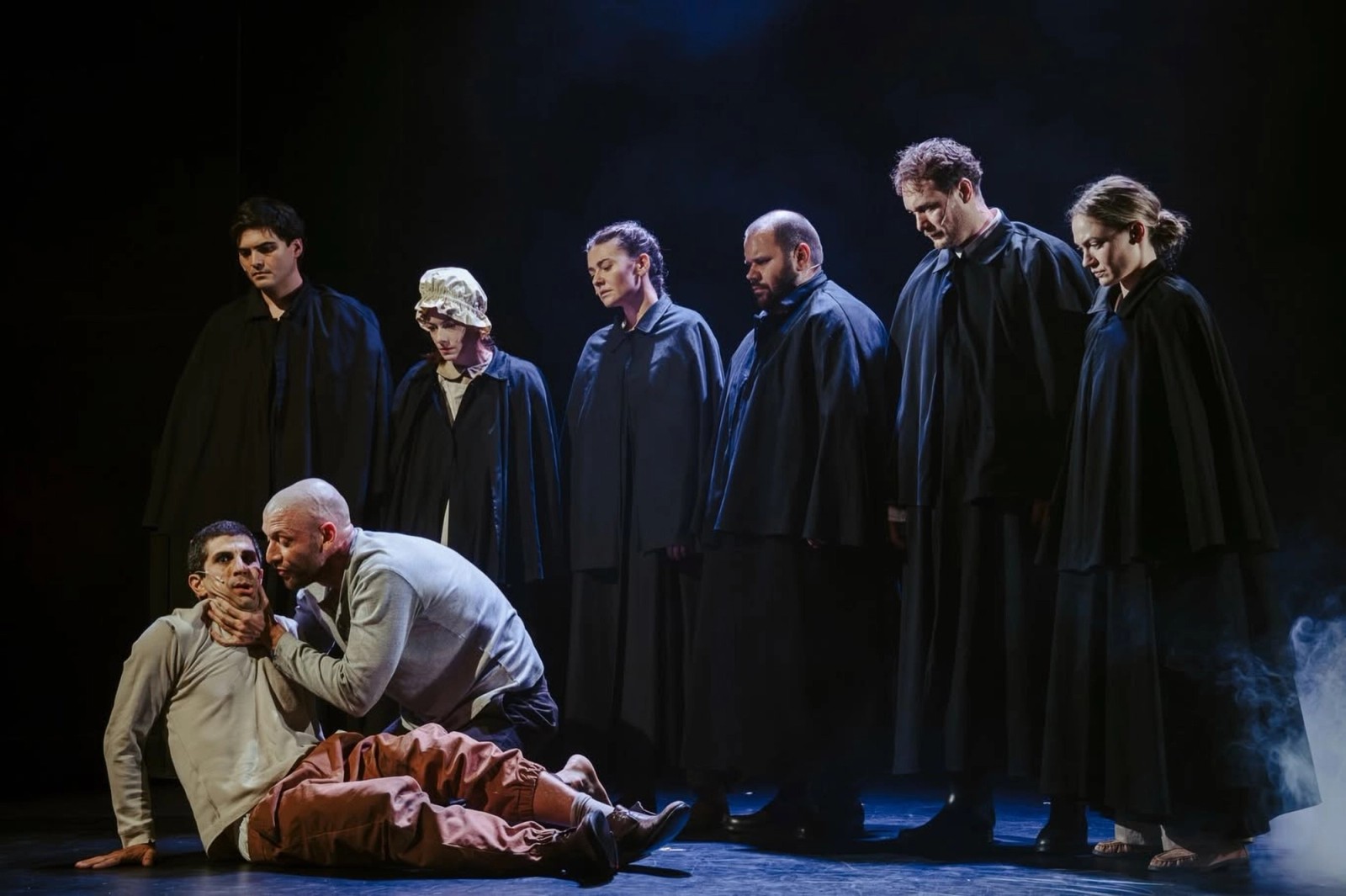
Huțuleac describes his production as “a crucible of memory”, in which a grown-up Pip watches his own becoming “with lucidity and empathy” and rediscovers the characters who once seemed enormous to him as “less monstrous and more human, prisoners of their own wounds”. And about Dickens’s relevance today he says something that is, for me, the clearest statement of what is at stake: we live in a culture that constantly pushes us to become something else, better, shinier, more visible, and we are almost never encouraged to ask whether the road we have set out on comes from an authentic desire or from a deep shame we are trying to cover up.
Here Huțuleac hits the mark exactly. Because Great Expectations is not, as it is sometimes taught in school, a novel about social climbing. It is a novel about shame, and the climbing is only the symptom. Pip does not want to be rich; Pip wants to stop being ashamed of his hands, his boots, the way he says words. The fortune is only the means by which he hopes to buy his way out of his own skin. And Dickens, who had himself been the child in the boot-blacking factory and who never told even his wife, knew everything there is to know about shame.
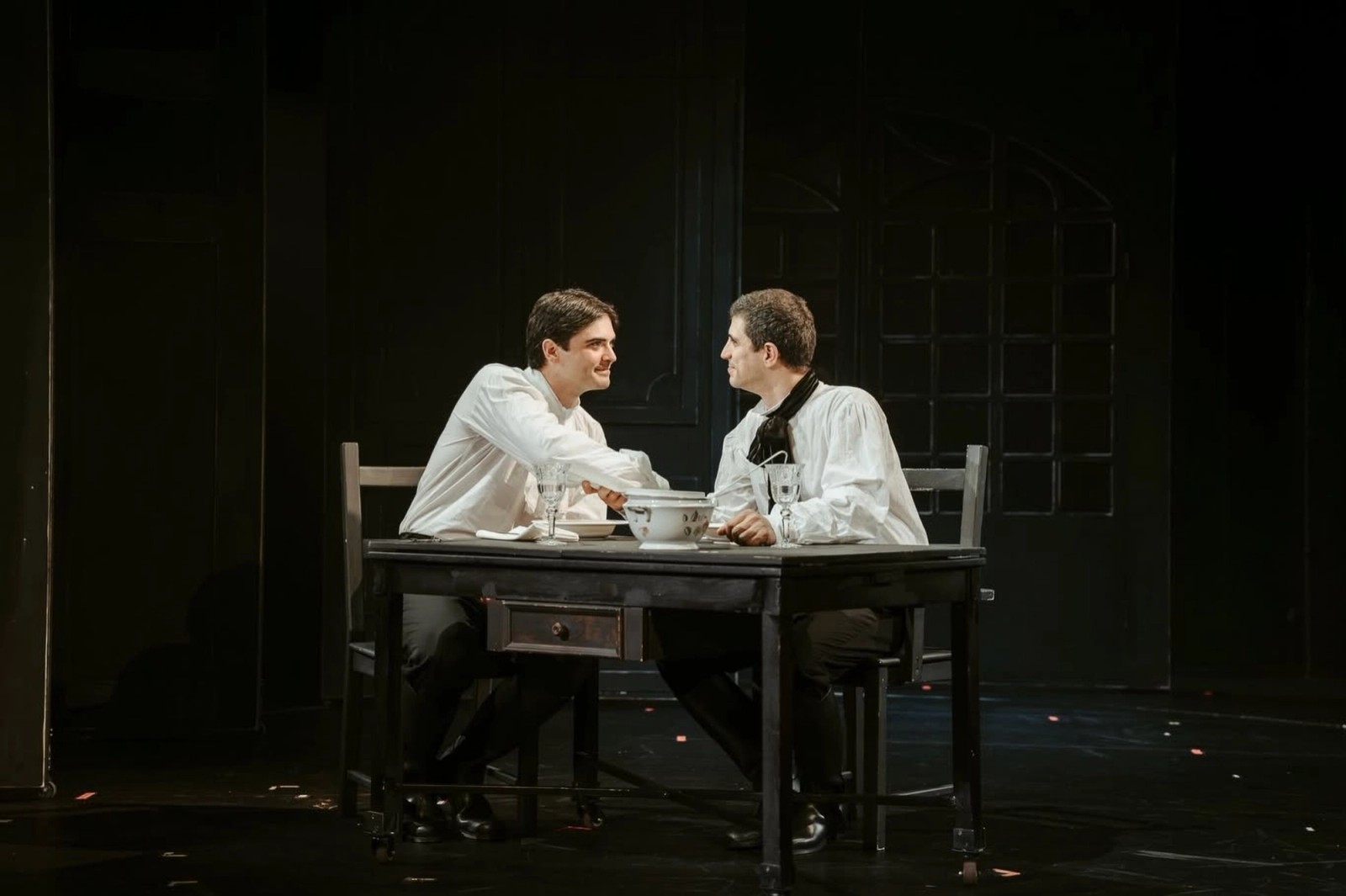
It is interesting, and I think not by chance, that Huțuleac comes to Dickens by way of Tennessee Williams. The Glass Menagerie opens with Tom telling the audience that the play is memory, and that memory lies. A Streetcar Named Desire, which he staged at Thin Red Line, is in turn built on a past that comes back to collect. A director who has worked twice with the American drama of remembering, and who now lands on Dickens’s most retrospective novel, is not changing the subject; he is continuing it by other means.
With the classic care for a three-layered telling, the direction, the actors and the technical crew worked together, fantastically, on a kind of genuine immersion, without denying the obvious (and/or the audience). Some of the characters, the ones with a narrator’s streak, invited the audience into the story with more than a wink (I’m not sure it will stay the same from one performance to the next, but I’d say the surprise is worth it: the kind of moment when a costume change takes time, so it has to be doubled, for comic effect, by a stretch of imagination on the scale of the musical Frozen (& Co.)).
A welcome care for mirroring a Victorian-style realism in something so lively, so strongly energised: through sets that seem enchanted, as if moved by the theatre’s draughts rather than by the people backstage; through the conventions of a subtly functional comedy; through characters taken off and put back on at speed; and through a very good command of every character played. Here I want to put on record, in black and white, Matei Arvunescu, who plays Mr Pumblechook, Herbert Pocket, Compeyson and Sarah Pocket, at one point all at once, with a staggering precision that simply brings (you) to life and multiplies (you too).
And in the thick crust of the delicious Shepherd’s Pie that Great Expectations turns out to be, the middle is just as memorably thought out. I did have my issues with the ending, as it happens, and with literary history’s choices on the subject, which has had its fair share of debate. Over a beer post factum I told Andrei that it blew me away, all of it, except the ending. Andrei respects Bartlett’s architecture, with a fine touch! of an ending that trails off. Pip and Estella meet again after eleven years, have a lo-fi conversation about each other’s lives, then Estella says “tell me we can stay friends, Pip” and holds out her hand. Pip does not return the gesture.
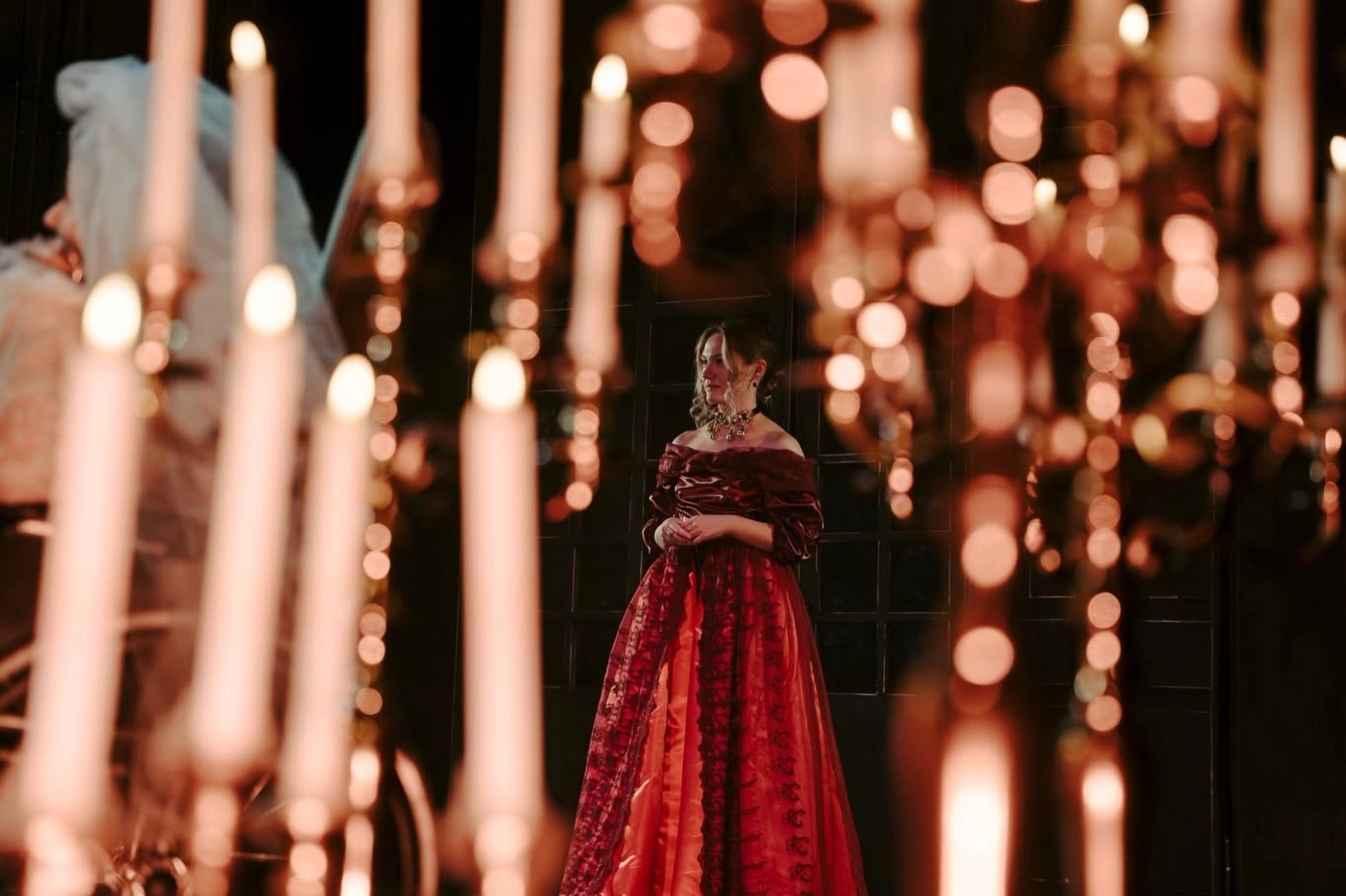
Ever since I first read it as a kid (I was in second grade, I think), I had known the second ending. The one where, “in all the broad expanse of tranquil light”, Pip saw “no shadow of another parting from her”. Now I know it’s cheesy, but it seemed to me the Victorian epitome; something in it tickled the reader I was then and the writer I would become. And I told Andrei: look, my “great expectations” were that it would end somehow in that key, or not necessarily, but maybe with some gimmick that wouldn’t make everything feel banal, like a cup that breaks when you don’t hold it carefully. He explained that it’s simple, that the resolution comes from Pip’s refusal to react, and I didn’t believe him (I needed a little more substance, not emphasis! aesthetics... that’s how it is...).
But my argument is that all his life other people told Pip what to do. The blacksmith and the lawyer, the fake uncle and the parish clerk, the eccentric old woman, the great love and disappointment of his childhood, the escaped convict, the new social class he was given access to. With all that in mind, even if not through quite such a Disney gaze, what would have fulfilled the fantasy the production had so carefully built in me until then (of being a kind of Pip myself) would have been for him to have the last word. To claim, for the first time, his disappointments, his decisions, his expectations, in the end. And the next day Huțuleac texts me: “Prince, I changed the ending.” (Not along the lines I had in mind, of course, but still.) So what is even more interesting now is the fluidity with which a production reaches its crystallised, canonical form, the one that can be played by the recipe for decades to come. And it really does feel like one of those productions, God willing!
What strikes me as most honest about this staging of expectations is that it doesn’t try to turn Dickens into a contemporary; it doesn’t put the characters in hoodies so we understand it’s about us. The argument is subtler and better: nothing needs updating, because the mechanism of shame was never switched off. Only the interface changed. In 1861 shame was called an accent and calloused hands; in 2026 it goes by another name and has analytics. And the Excelsior (a small, useful note: type the full “Teatrul (...)” into Maps, because if you type only “Excelsior” it sends you to the near-namesake restaurant on Știrbei Vodă), which also puts a 12+ recommendation on the poster, does exactly what it should with this production: it doesn’t tell its audience they will succeed if they want it badly enough; it puts in front of them a boy who wanted it badly enough and shows them what it cost him.
I wanted badly enough to see the show, too. I know because I waited outside a little early, and right next door there is a restaurant that had been sautéing prawns in butter. That butter, the garlic, the thyme, the lime smelled so good that my mind skidded about three times towards walking through the wrong door (on purpose). Andrei told me he thought the God of Theatre was on his side that day. And so He was.
- WordsAlberto Păduraru
- PhotographsCosmin Kleiner Stoian / Teatrul Excelsior
- Published · TINCT Art & Culture
- Reading time13 min
- Sources
FAQ
- Who directs Great Expectations at Teatrul Excelsior?
- Andrei Huțuleac directs it, in Neil Bartlett's adaptation and Adrian Nicolae's translation. It plays in the Ion Lucian hall at Teatrul Excelsior, with a 12+ recommendation on the poster.
- Who is in the cast of Great Expectations at Teatrul Excelsior?
- Eight actors play the whole novel. Alex Călin is Pip, Camelia Pintilie is Miss Havisham, Ioana Niculae is Estella, Mircea Alexandru Băluță is Magwitch, and Mihai Mitrea, Loredana Cosovanu, Matei Arvunescu and Ovidiu Ușvat each take several roles.
- How does Neil Bartlett's adaptation of Dickens work?
- Neil Bartlett came to the novel at the Bristol Old Vic in 2013. His rule is that only Dickens's words are used, cut and reassembled, and eight actors play everything, doubling the characters and solving the rest on stage.
- Why does Dickens's novel have two endings?
- In the summer of 1861 Dickens gave the proofs to Edward Bulwer-Lytton, who found the original ending, a brief meeting of Pip and Estella on Piccadilly, too harsh. Dickens rewrote it, and almost every serious edition now prints both.
- Why did Dickens write Great Expectations as a weekly serial?
- At the end of 1860 his magazine, All the Year Round, was sinking because readers had abandoned Charles Lever's serial A Day's Ride. Dickens took over the writing himself, and the weekly format produced his most tightly built novel.
Where and when
Marile speranțe
Teatrul Excelsior · City Centre
Neil Bartlett's adaptation of Charles Dickens' 'Great Expectations' is directed by Andrei Huțuleac. The production features original music by Matei Vasilache.