The Cantina That Outlived the Server
When Star Wars Galaxies disappeared, its residents lost more than a game. They lost places they had built for one another, and discovered how difficult a city is to archive.
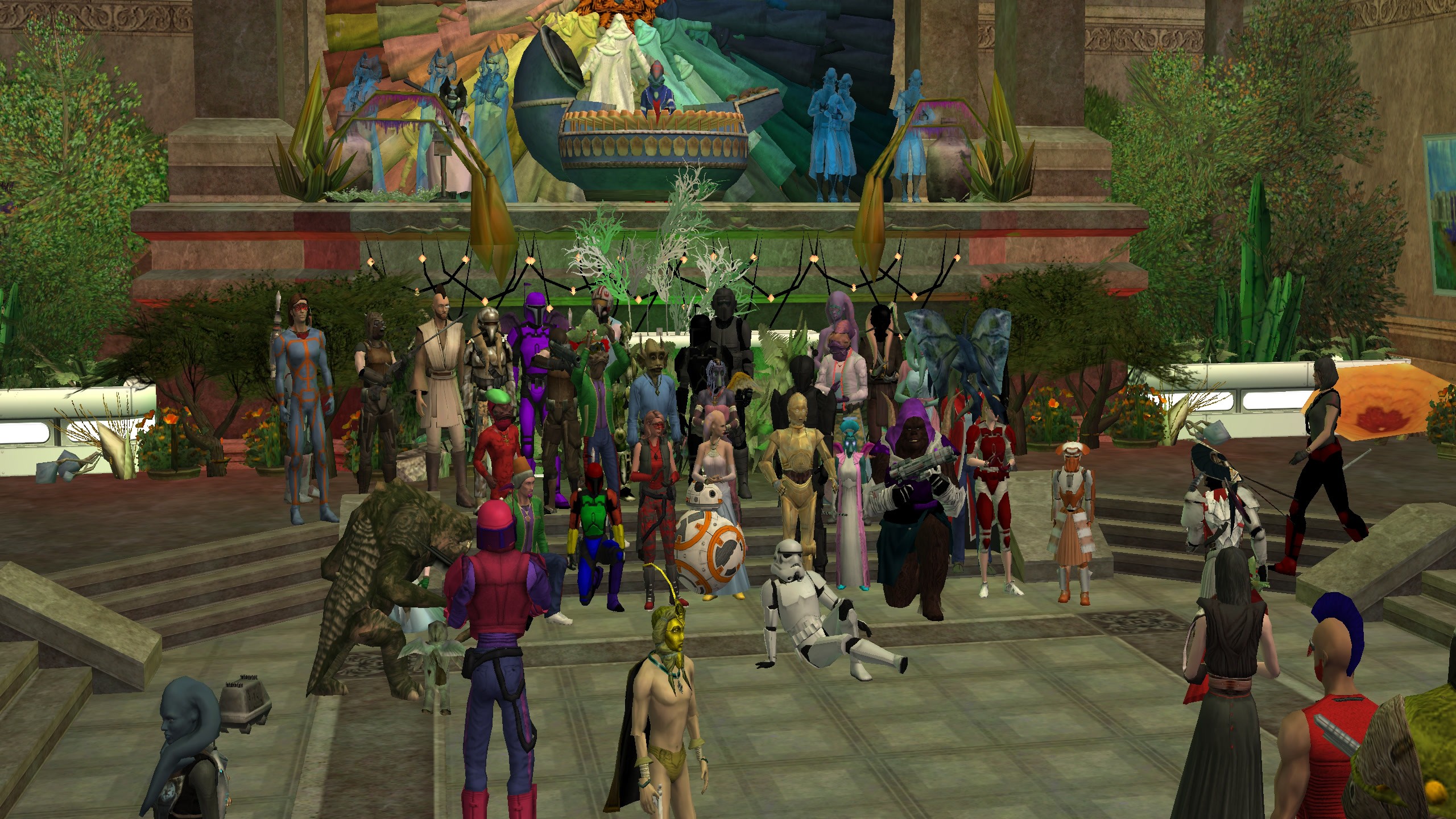
On the Starsider server of Star Wars Galaxies, a guild had turned a sail barge into something that was not quite a house and not officially a cantina. Members called it the Buff Barge. It was where they met before missions, gathered supplies, found an entertainer or medic, and waited for the rest of the group to arrive. On one memorable evening, a bounty hunter appeared at the door looking for a guild member. The target stayed upstairs collecting every available enhancement while friends occupied the visitor in conversation. When the target finally emerged, the confrontation had an audience. In a more conventional Star Wars story, this might have been the beginning of an important mission. Here, it was simply an evening at a local meeting place.
The story comes from Kyranna Mythina, a Starsider player interviewed by Karen Bryan in December 2011, as the official game approached its shutdown. Kyranna's published recollection is an unusually specific surviving record of a place that was meaningful because of what people did there. It also makes the word cantina more interesting. A cantina did not necessarily have to be a building classified as one by the software. It could be a barge that a group adopted, furnished and returned to until the space acquired a social function that no designer had written into it.
On 15 December 2011, Sony Online Entertainment and LucasArts ended the official Star Wars Galaxies service. The planets were still part of Star Wars fiction, of course. Mos Eisley had not been erased from the films. But a guild's barge, a player's shop, a town hall and the footpath everyone knew between them depended on a particular server, at a particular moment in its history. When that server ceased operating, those addresses ceased to be reachable. What survived was scattered among screenshots, forum posts, interviews, old guides, videos and the people who remembered where to turn.
First, you had to build a town
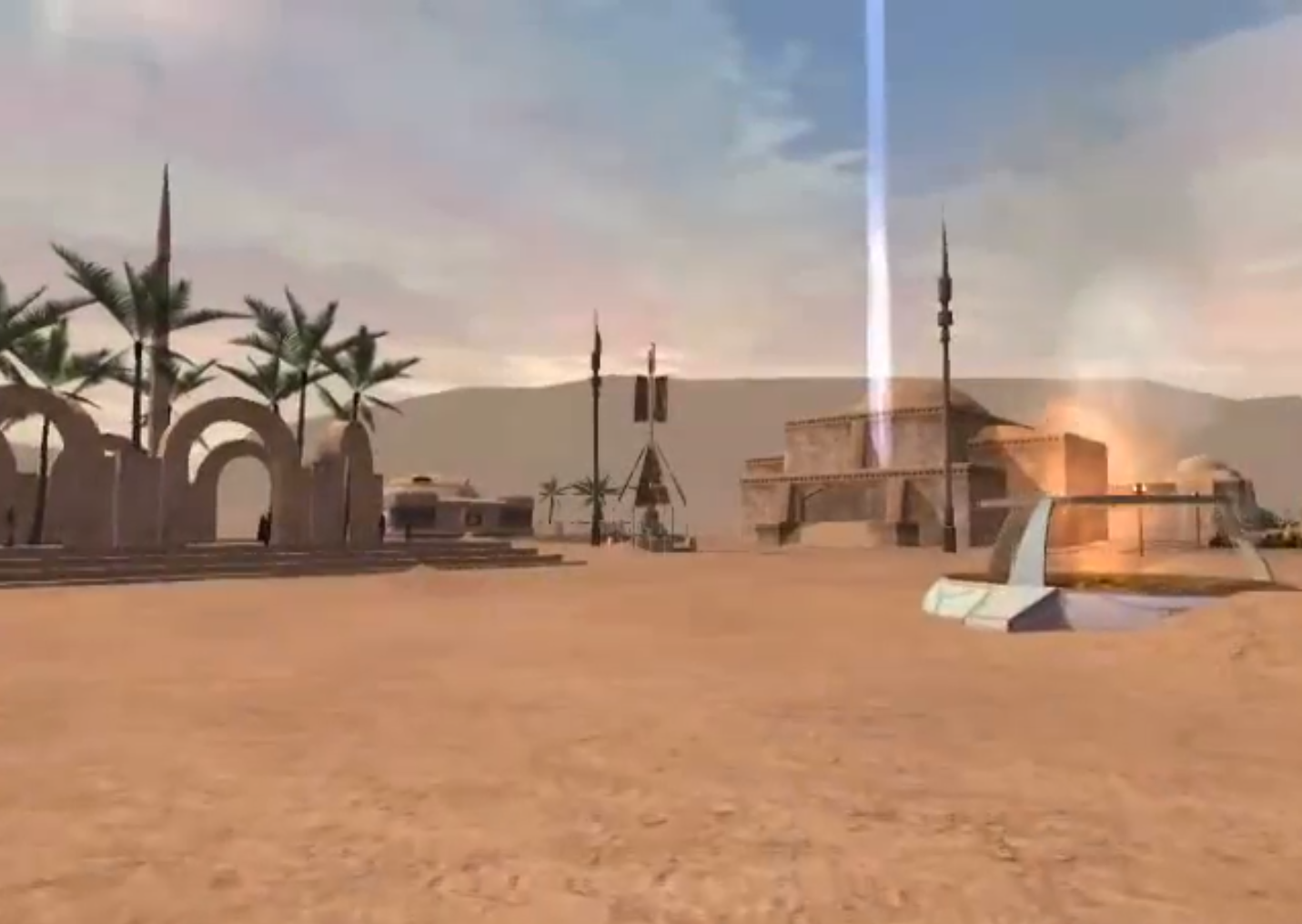
One way to understand the loss is to look at the work of creating a place in the first instance. In a 2012 interview published by Game Informer, Linda Carlson, who played Galaxies before joining Sony Online Entertainment, described what her guild did when player cities became possible. The Consortium was not primarily interested in conquering planets. It wanted to build and trade. Its members surveyed land on Lok, divided it into plots and even organized a zoning department so people could position their homes. Carlson trained as a politician and returned to place the guild hall for a settlement that became Consortia. The moment mattered to her not because a quest had been completed, but because a group had brought a plan into existence.
A zoning department sounds like the least glamorous institution ever assembled in a galaxy of smugglers and space battles. It also explains why Galaxies was different. The game let people establish a place that other people then had to navigate. That place had an economy and a government, in the limited but concrete terms of its rules. A player-written city guide preserved from the official forums, updated in February 2005, describes a system of elected mayors, declared residency, city maintenance and communal buildings. Under the rules documented in that version, an outpost needed ten citizens; a village needed twenty and could support a player-placed cantina; larger settlements could unlock facilities such as hospitals and shuttleports. Elections recurred every three weeks. Buildings could be lost if maintenance failed or a city fell below the requirements for particular structures. The rules changed over the game's lifespan, but this record captures a revealing early arrangement: belonging had to be organized, funded and renewed.
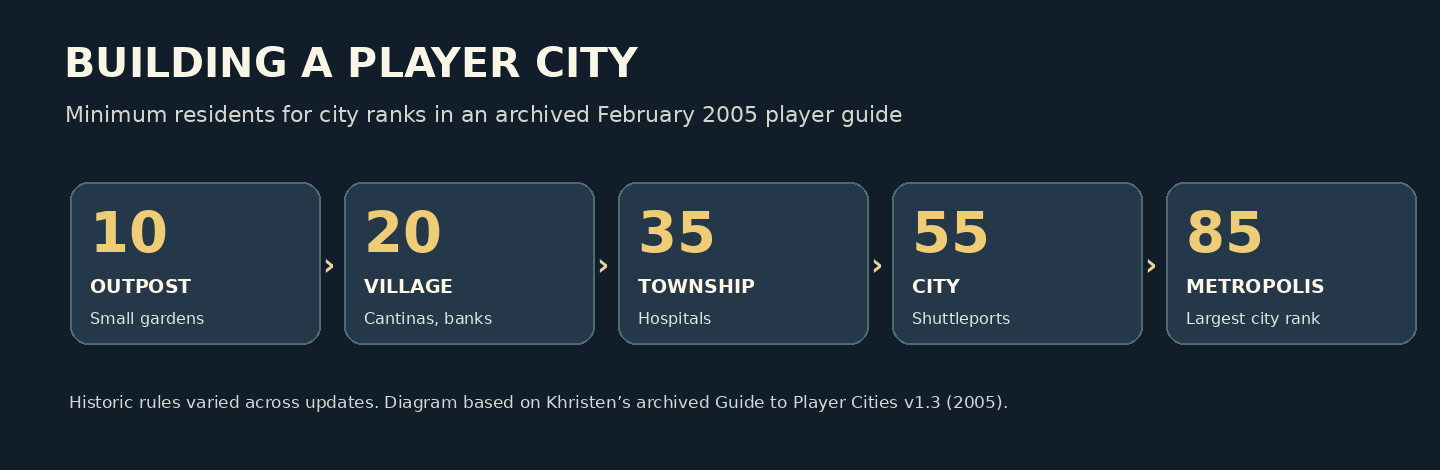
The guide is a small historical artifact in its own right. It is not a developer's promotional promise about a living galaxy. It is one player explaining to others how to make municipal life work. Near its end, the author, Khristen, includes a business address in Kor Spera on Corellia, complete with coordinates. Those numbers once directed someone to a useful place. Today they function more like the address on a postcard from a demolished neighborhood. They establish that something was situated there; they cannot recreate who was waiting inside.
In a single-player game, the town usually remains where the level designer put it. The shopkeeper repeats a line, the tavern fills with familiar faces, and the road stays put between visits. A player-built settlement in Galaxies was less certain. It could expand, lose citizens, move its center of activity or become quiet when the people who sustained it left. This fragility was not separate from the place's identity. It was the condition of having a town made partly by its residents.
A cantina was also a piece of infrastructure
It is tempting to remember every Galaxies cantina as a cheerful room full of music, dancing and effortless friendship. The contemporary evidence is less tidy, and therefore more interesting. In 2004, researchers Nicolas Ducheneaut and Robert J. Moore studied interactions in a cantina and a starport, using interaction logs, video and ethnographic observations. Across 26 days, 3,564 distinct characters visited the cantina they observed. Many visits were brief and practical. Combat characters came to recover battle fatigue by watching dancers or listening to musicians. Entertainers could gain experience by performing. People were brought into proximity not only by their desire for conversation, but by the way professions and recovery mechanics fit together.
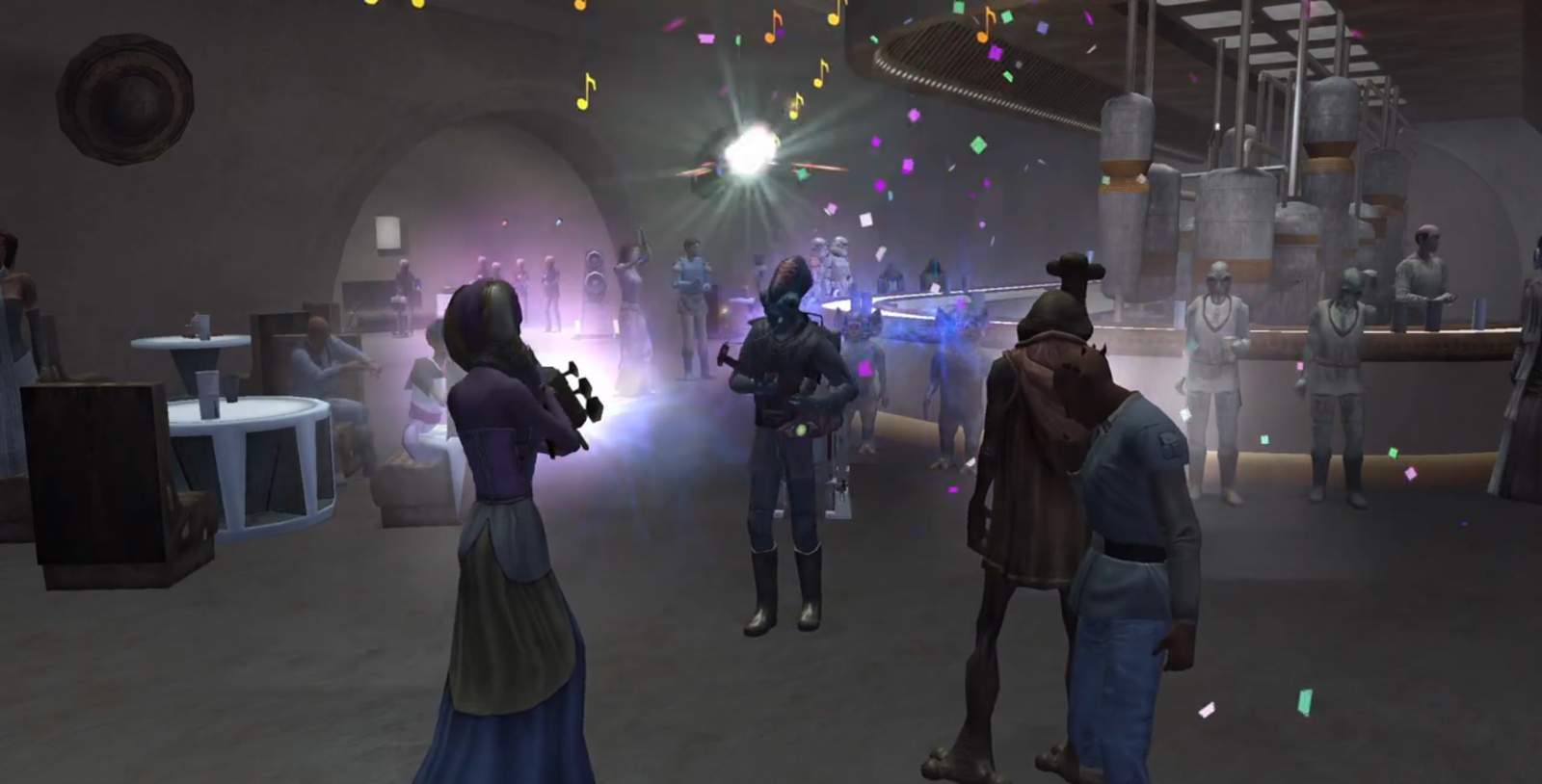
The researchers also found an awkward feature of this supposedly sociable world: some performers were controlled by automated macros rather than people actively responding to others. Players sometimes encountered repeated advertisements and apparently social gestures with nobody meaningfully present behind them. The cantina could be a genuine gathering place and an efficient service counter, sometimes at the same time. Ducheneaut and Moore identified both instrumental encounters and longer, responsive conversations. Their study concerned particular locations and a particular period; it cannot tell us how every guild or every cantina behaved. It does, however, warn against turning the past into an uninterrupted party.
A place does not become important because everyone inside is friendly. Real bars, shops and transport stations are full of people who are tired, distracted, working, waiting or simply passing through. Galaxies produced something similar by making its professions depend on one another. Players had reasons to stop. The pauses created opportunities for exchange, and occasionally a barge full of guildmates became the stage for an improvised confrontation with a bounty hunter. The space acquired stories because it was used, not because it was designed to be memorable.
That distinction matters for preservation. A screenshot can record the furniture and the avatars. An old guide can tell us why a dancer was there. A log might show a conversation. No single artifact captures the routine that made the room familiar: who arrived first, which person always stood near the entrance, when it was worth visiting, or why one particular stranger at the door was instantly recognized as trouble.
The map that came back as a memory
The remains of these places sometimes surface in unexpected forms. In March 2026, a person posting to the Star Wars Galaxies community on Reddit described discovering their own character in a screenshot printed in a Dutch gaming magazine from 2004. They identified the scene as Lianorm, a player-built settlement for Dutch and Belgian players on the Eclipse server. The post is a first-person claim made years after the fact, not an independently reconstructed town record, but its specificity is striking. An image that had circulated as magazine illustration became an unexpected piece of personal geography when someone recognized a figure inside it.
A few months later, another community post collected the names of early player cities from the original servers. Responses recalled places such as Goliath and Mos Tyrenia, with one commenter remembering being present when the first building went down. Again, these are public recollections rather than verified oral-history interviews. But the responses show how a proper name can act as a key. An old list of settlements is no longer only a piece of server history. For the people who lived in them, it is a partial map of former relationships.
There is an important difference between preserving Star Wars Galaxies as software and preserving the histories of these settlements. A working copy of the game can reproduce the rules that made housing, cantinas, trading and municipal politics possible. It cannot automatically restore Consortia at the moment Carlson's guild finished its plan, or recreate the exact gathering inside Kyranna's barge. Those were outcomes of particular people meeting at particular times. Even if the architecture survives as data, the event does not replay itself just because a server starts.
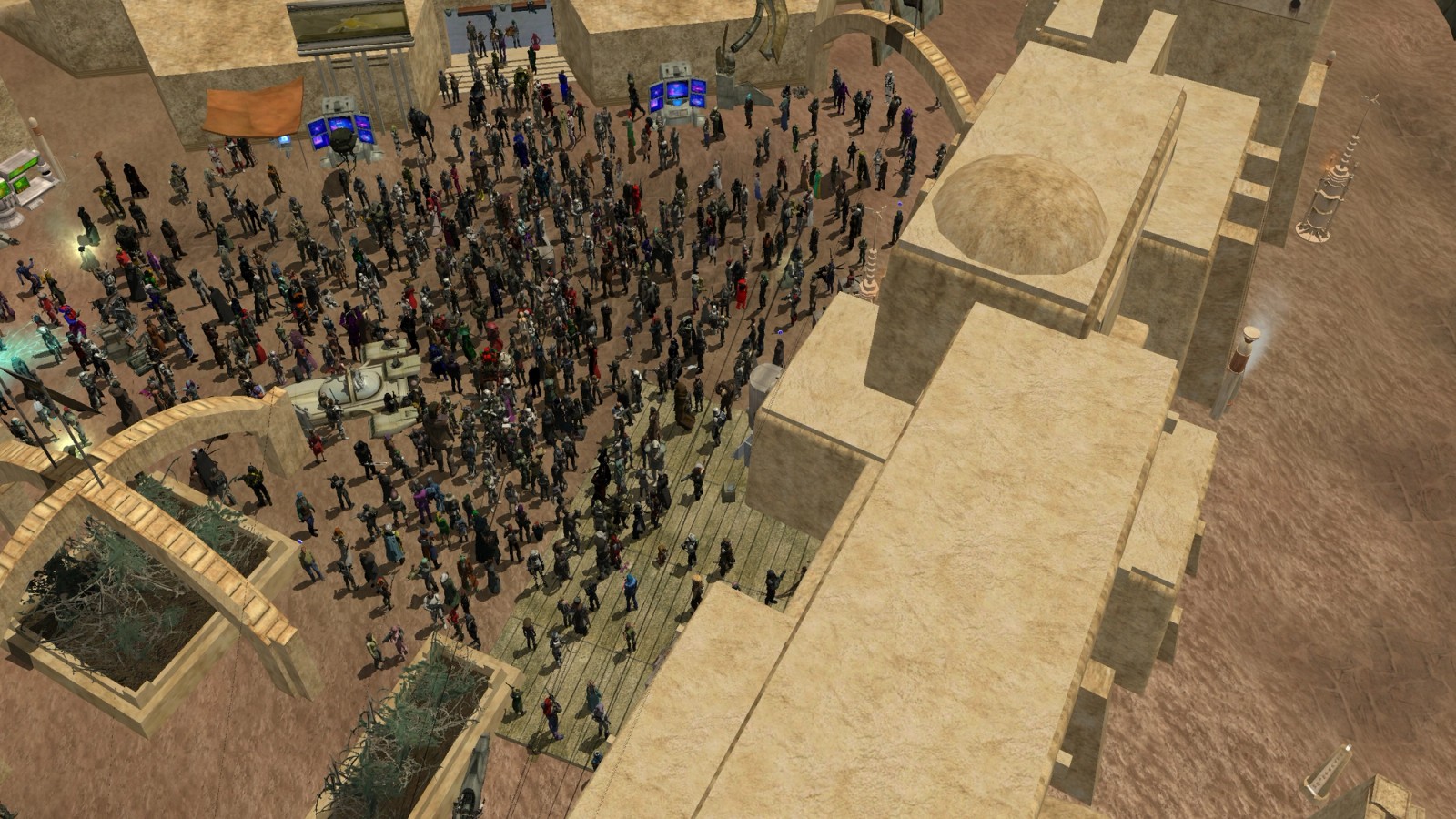
This is why the surviving records are so uneven. An archived screenshot of New Wookiesburg on Lok shows a player-built settlement; a screenshot of a player-operated city mall records a commercial arrangement that would otherwise be hard to picture. Neither image tells us who negotiated the plots, how long a vendor stayed, or which route locals took home. That information sits elsewhere, when it survives at all, in the less glamorous material of forum instructions, interviews, videos and remembered names.
What a shutdown actually removes
The closure of Galaxies was not an unexplained catastrophe. In a 2011 interview, Sony Online Entertainment president John Smedley described the ending as a business decision agreed with LucasArts, with the licensing arrangement approaching its conclusion. A game service can end for reasons entirely separate from the value players attach to individual places inside it. The company closes an operating product; residents experience the disappearance of shared infrastructure.
Kyranna's account makes the mismatch unusually tangible. She told Bryan that she had gathered more than 200 gigabytes of footage to make a short tribute to Galaxies, and planned to take screenshots during its final hours. Her guildmates, she said, had already arranged to meet again in The Old Republic. The community could move, but it could not carry the Buff Barge with it in the same sense that people carry furniture or a neighborhood café to a new town. The relationships might continue elsewhere; the original room would remain attached to the world that hosted it. Sony Online Entertainment itself released a 252-page Star Wars Galaxies Memory Book after the shutdown, an unusually literal admission that a digital world could require its own commemorative archive.
The story did not end there. Community projects such as SWGEmu, SWG Legends and SWG Restoration have worked to make versions of Galaxies playable again, preserving and adapting different periods of the game. It matters to be precise about what this means. A contemporary player city is not a continuation of an individual town from the original servers merely because it shares the same kind of buildings. The old residents, economy and local history do not materialize with the software. But the conditions under which new communities can make places have returned. In a 2024 feature on SWG Restoration's Black Sands, residents describe the One-Eyed Squill Tavern as a center for role-playing and events, surrounded by businesses and other gathering sites. This is a new community demonstrating an old principle: a place needs people to give it a use that extends beyond its walls.
The question raised by Galaxies reaches well beyond one Star Wars game. Digital platforms increasingly provide the rooms in which people learn to recognize one another. A platform owner can maintain, redesign or discontinue those rooms, often for perfectly conventional business reasons. Yet what residents have built there may include routines, informal institutions, local reputations and memories that no export function was designed to carry. The right to access a server is not quite the same thing as ownership of a place, and the right to run similar software does not guarantee the return of the people who made that place matter. That history of Star Wars games, communities and the worlds they created is also a history of what conventional preservation struggles to capture.
We are used to thinking of vanished digital worlds as obsolete files. The evidence left by Star Wars Galaxies asks us to think about them more like neighborhoods. Consortia had a zoning department. Lianorm acquired a place in someone's family and gaming memory. A sail barge became the Buff Barge because a guild decided it was where they would meet. None of these things needed to be a landmark in the official Star Wars canon. They only needed to matter to the people who could find their way there.
And when the last server went dark, a cantina could still exist in one limited, stubborn sense: a former resident could tell you who was upstairs, why the bounty hunter was waiting outside, and how the room had become home.
- WordsSøren Kamper
- PhotographsSWG Legends; Søren Ahrensborg Kamper
- Published · TINCT Art & Culture
- SeriesSystems
- Reading time11 min
- Sources
FAQ
- What was the Buff Barge in Star Wars Galaxies?
- The Buff Barge was a sail barge on the Starsider server that a guild adopted as its meeting place. Members gathered there before missions, found supplies, an entertainer or a medic, and waited for the rest of their group.
- When did Star Wars Galaxies shut down?
- Sony Online Entertainment and LucasArts ended the official Star Wars Galaxies service on 15 December 2011. Sony Online Entertainment president John Smedley described it as a business decision, with the licensing arrangement approaching its conclusion.
- What was Consortia in Star Wars Galaxies?
- Consortia was a player-built settlement on Lok, made by Linda Carlson's guild, The Consortium. Its members surveyed the land, divided it into plots and organized a zoning department so people could position their homes.
- How did player cities work in Star Wars Galaxies?
- Under rules documented in 2005, an outpost needed ten citizens and a village twenty. Cities had elected mayors, declared residency and elections every three weeks, and buildings could be lost if maintenance failed.
- Can you still play Star Wars Galaxies?
- Community projects such as SWGEmu, SWG Legends and SWG Restoration have worked to make versions of it playable again, preserving and adapting different periods of the game. The original towns and their residents do not return with the software.