The greatest catch: how The Fishermen Quintet finally caught Schubert's Trout
They named themselves after the piece before they could play it. I followed the five of them from a flower shop in Bucharest to a kindergarten in 2 Mai to a beach at sundown.
How to catch a trout? Open any of the specialist magazines. You will find a whole industry built around the question. Baits in every colour. Advertisements for rods described the same exact way other magazines describe sports cars. Tips and tricks that go as deep as the trajectory the line should travel. The pressure of the water where it lands. All of it to improve your odds against one fish. Then the photograph with the catch. One good old story you tell at the same bar for the next fifteen years. And the small but rather eternal glory that comes with it.
That is what the average fishing enthusiast would tell you. What he is aiming for. Ask The Fishermen Quintet and you get a completely different answer.
I can already hear you. "Shepherd, are you really about to write a full-length article about catching a freshwater fish that tops out around ten kilos?" Sadly, no, dear reader. Let's get back to it.
Five men, one boat
The Fishermen Quintet. A fitting name, don't you think? Five musicians who met at the National University of Music in Bucharest, started playing together informally the way students do, and never quite stopped. Fabiani Prcsina, the piano-man. Ștefan Ristea, aka violin-man. Filip Forna on viola. Ștefan Ciceu, on double distribution with his younger brother Luca, or as he calls himself, Cicello. Șerban Mihai playing double bass. One exquisite lineup of young artists and friends, driven by the same passion for music, having loads of fun along the way.
I am Bemol. Flatten me by a semitone and you'll believe me less. […] There were five of them. I'll name them later. For now you know them by what they're like and what they do.
Eu sunt Bemol. Coborâți-mă cu o jumătate de ton și-o să mă credeți mai puțin. […] Erau cinci. O să le spun pe nume mai târziu. Deocamdată îi cunoașteți după cum sunt și ce fac.
A standard piano quintet is a piano and a string quartet: two violins, viola, cello. In 1819 Schubert threw out the second violin and put a double bass in its place, and almost nobody has written seriously for that combination since. Which means a group assembled in this exact shape is not a chamber ensemble that happens to enjoy Schubert. It is a group built around a single piece of music. They named themselves after the fish before they had caught it.
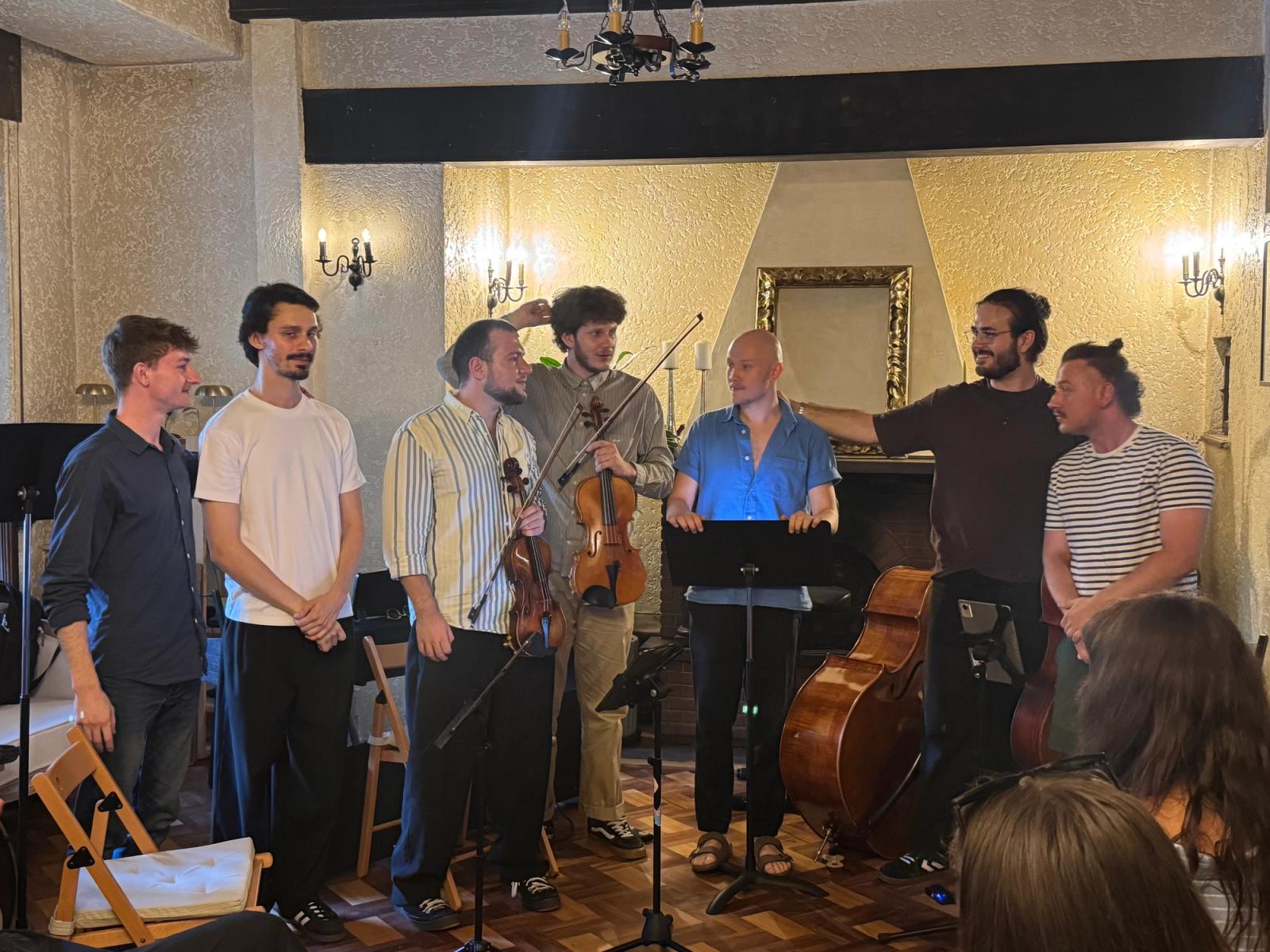
Since forming, they have taken Bucharest's classical scene at a run: Doro-16 on Dorobanți, the Institutul Cultural Român, Casa Libertății Religioase in Cluj-Napoca, a performance for the Austrian embassy, an A-list Magazine party, and even a night at Club Guesthouse, one of Bucharest's legendary nightclubs, which is not a room built for a double bass and a Nutcracker. Seasoned fishermen, then. But like any decent bar story, the one untamed beast kept getting away. The catch that gave them their name and their mission, and that would eventually send them out on an expedition of brotherhood, argument and self-discovery: Schubert's Trout.
What is The Trout, exactly
By its full name: the Trout Quintet, D. 667, in A major. Schubert wrote it in the summer of 1819, at 22, while on holiday in Steyr in Upper Austria. A piece for a wealthy amateur cellist named Sylvester Paumgartner who asked for something built around a song he already loved. It runs to five movements instead of the usual four. The fourth is a set of six variations on Schubert's own 1817 lied Die Forelle, and in each variation the melody moves to a different instrument, so the tune gets passed around the room like a bottle. It was published in 1829, a year after Schubert died. He never heard it played in public.
The song underneath it is darker than its reputation. The poem is by Christian Friedrich Daniel Schubart, written in 1782 from a cell in the Hohenasperg fortress, where he spent ten years imprisoned without trial. A trout darts around in a bright stream. An angler waits on the bank, fails, and then muddies the water so the fish cannot see, and takes it. Schubart wrote a fourth stanza spelling out the moral, a warning to young women about men with tackle and patience. Schubert cut it. What survives is just the trout, the water going cloudy, and the catch. The rest is pure interpretation.
The secret rehearsal
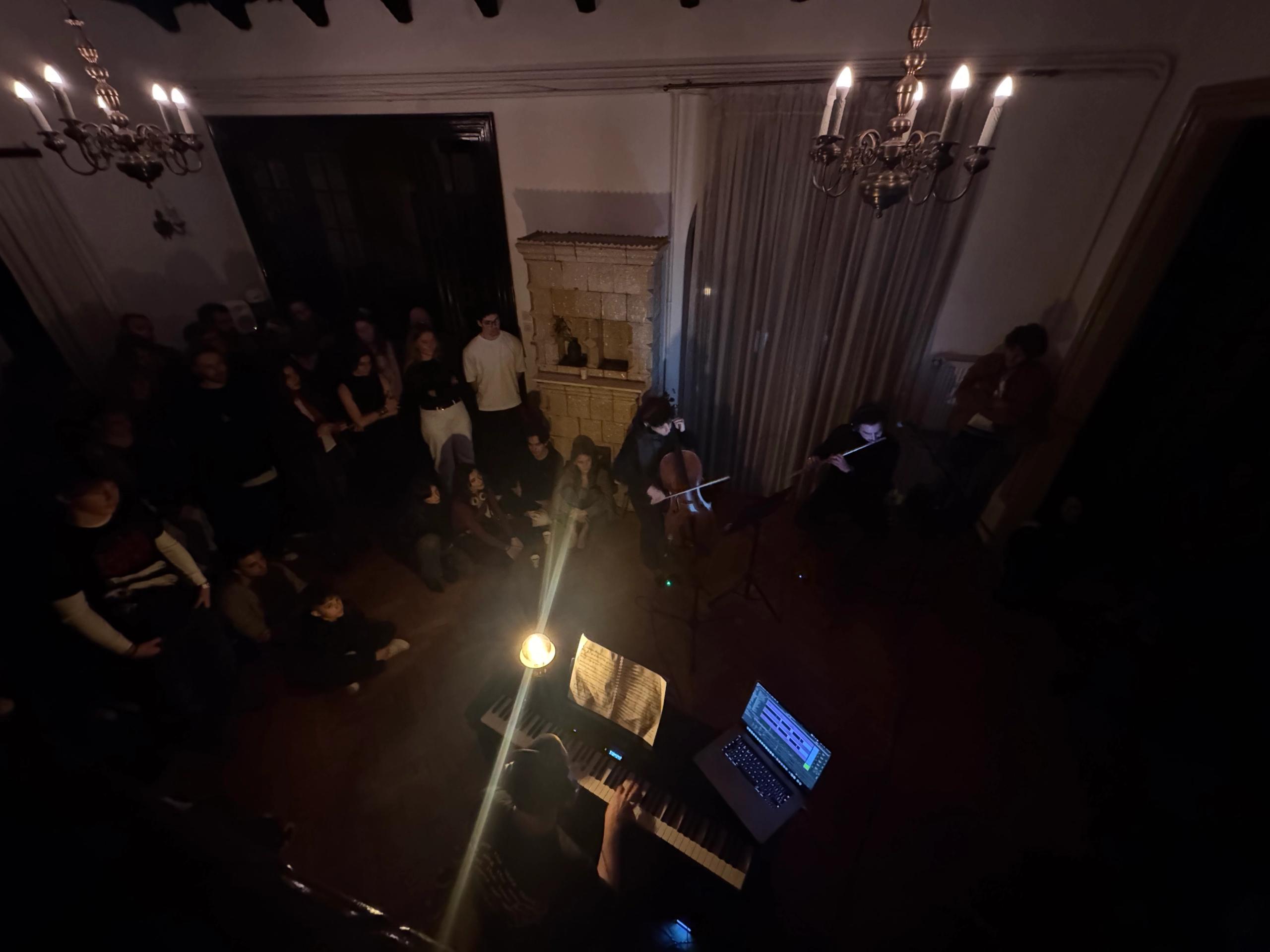
Because no serious expedition begins without preparation, I met the boys at enRose, a floral design workspace inside a neo-Romanian house on Christian Tell, tucked down a quiet dead end behind the noise of Piața Romană.
I pulled up next to the building and there was already a crowd outside, mostly friends, friends of friends and people rather close to the Quintet, waiting to witness a secret rehearsal. Inside, a heavily ornamented marble staircase opens straight ahead. To the left, a large living room: wall decorations, solid wood furniture, and a small jungle of plants running through all of it, because we are in a flower shop after all. On the wooden floor the instruments sit waiting, chairs arranged around them for a public that has not arrived yet.
Then it does. The room fills and closes into a semicircle around the musicians. This was supposed to be a secret rehearsal, but apparently a lot of people wanted to watch the trout finally get caught, so everyone took whatever position they could find: standing, leaning against the marble staircase, anywhere with a view of the rod bending.
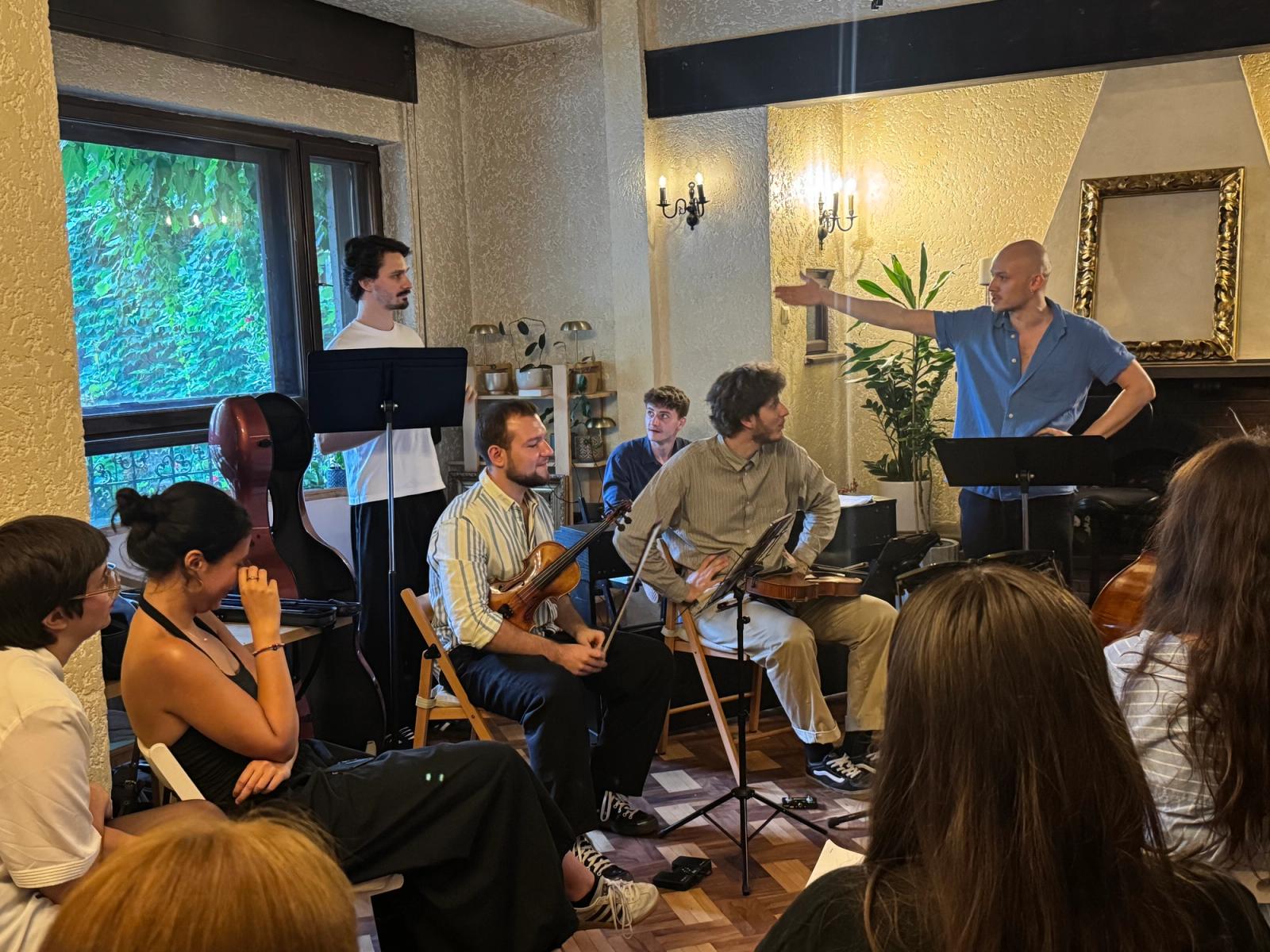
Time to introduce the two other sailors on this voyage. Alberto Păduraru turned Schubert's notes into words so that the boat and the audience could read the waters. Call him the map master. And Iosif Paștina, one of the best actors of his generation to play a parrot, whimsically comic in his ways, lends those words a voice. Call him the navigator, surrealist bird of the crew assembled. And sure, there is a storm coming.
Iosif opens as Bemol, the ship's parrot, introducing the crew: five fishermen, five best friends, each with his own way of being difficult, boarding a boat for an expedition no different from the hundred before it. As he speaks, the boys begin to move in under him, the piano laying down its opening ripple, the strings arriving underneath, sea and endless blue folding into the sound until the room stops fidgeting.
What follows is the ride. Something Paul Auster might have written if he had been into magic. Rods that turn into instruments. A talking parrot. Fish the size of dinosaurs. The discovery that if you twist your bow towards the sky at the wrong angle, you can start a storm by accident. The room goes from grinning to leaning forward to somewhere quieter and further in.
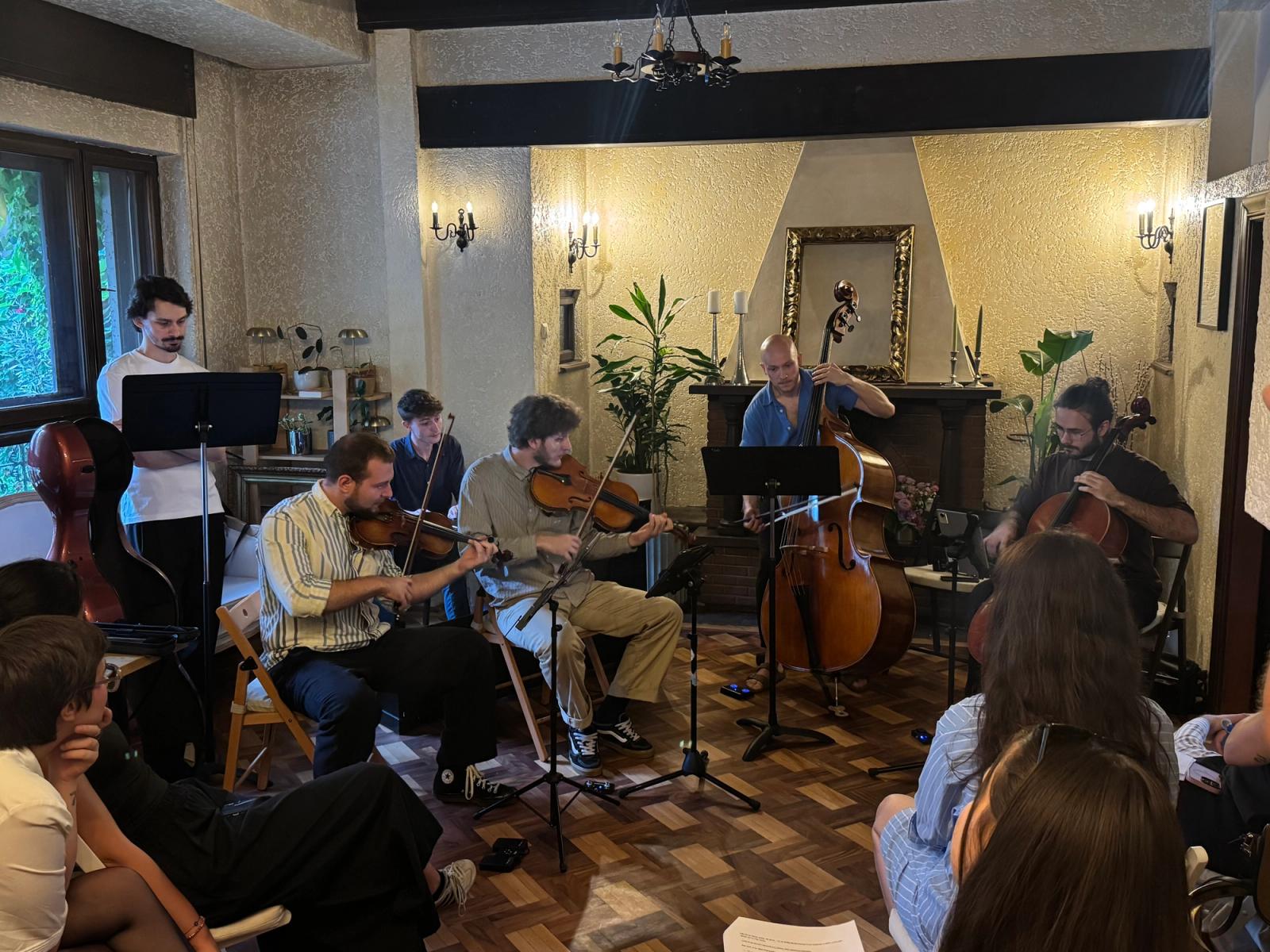
The disclaimer at the start was that this was a work in progress. Which means some rules have to be set. The most important: if the musicians, or the narrator, feel like it, they can re-take a moment, a stanza. The perfect rehearsal environment.
What I saw was a group of artists genuinely enjoying themselves and a crowd well past the room's capacity eating the whole thing whole. They had something and they knew it. I wanted more of it.
2 Mai
A few weeks later I met them again at 2 Mai.
Remember only this, a thing every parrot who has spent long enough on a mast knows: silence, on the water is never rest. It is only the breath the sea draws before it screams.
Țineți minte doar atât, că-i o vorbă pe care-o știe orice papagal care-a stat destul pe-un catarg: Liniștea, pe apă, nu-i niciodată odihnă, e doar răsuflarea pe care marea o trage în piept înainte să strige.
The village sits on the Black Sea coast in Constanța county, five kilometres from Mangalia and six from Vama Veche, founded in 1887 by Mihail Kogălniceanu as a settlement for fishermen and for the Bulgarian farmers, Russian refugees and Tatar horse breeders who came with them. Under communism it became the place artists and writers went precisely because nobody important was watching. They rented rooms from villagers, put the bathroom in the yard, called it a summer office and all knew each other. That reputation has outlived the regime that made it necessary.
We were there for ȘI festival, in its sixth edition: eight days, more than a hundred free events across eight spaces in a village of a few thousand people, which makes it the largest cultural event in rural Romania. Theatre, film, concerts, new media, workshops, conversations that run long.
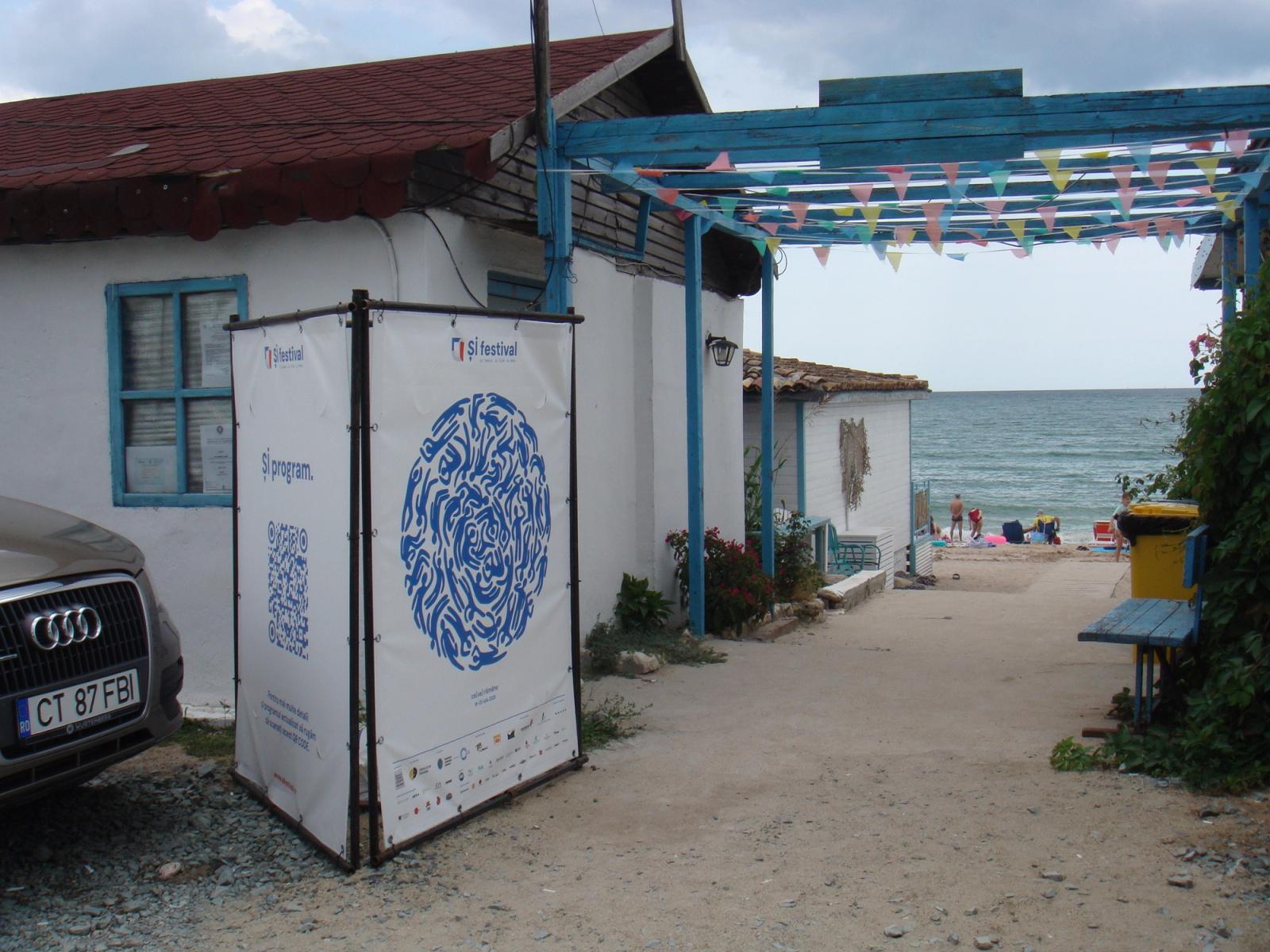
Between the sunbathing, the plays and the permanent low-grade party happening next to the water, the Fishermen were scheduled for the final day, on the sand next to Cactoos, in front of the whole festival. A band of fishermen playing a piece about a trout, on a beach, at the end of everything. It began to feel like the festival had been arranged around them.
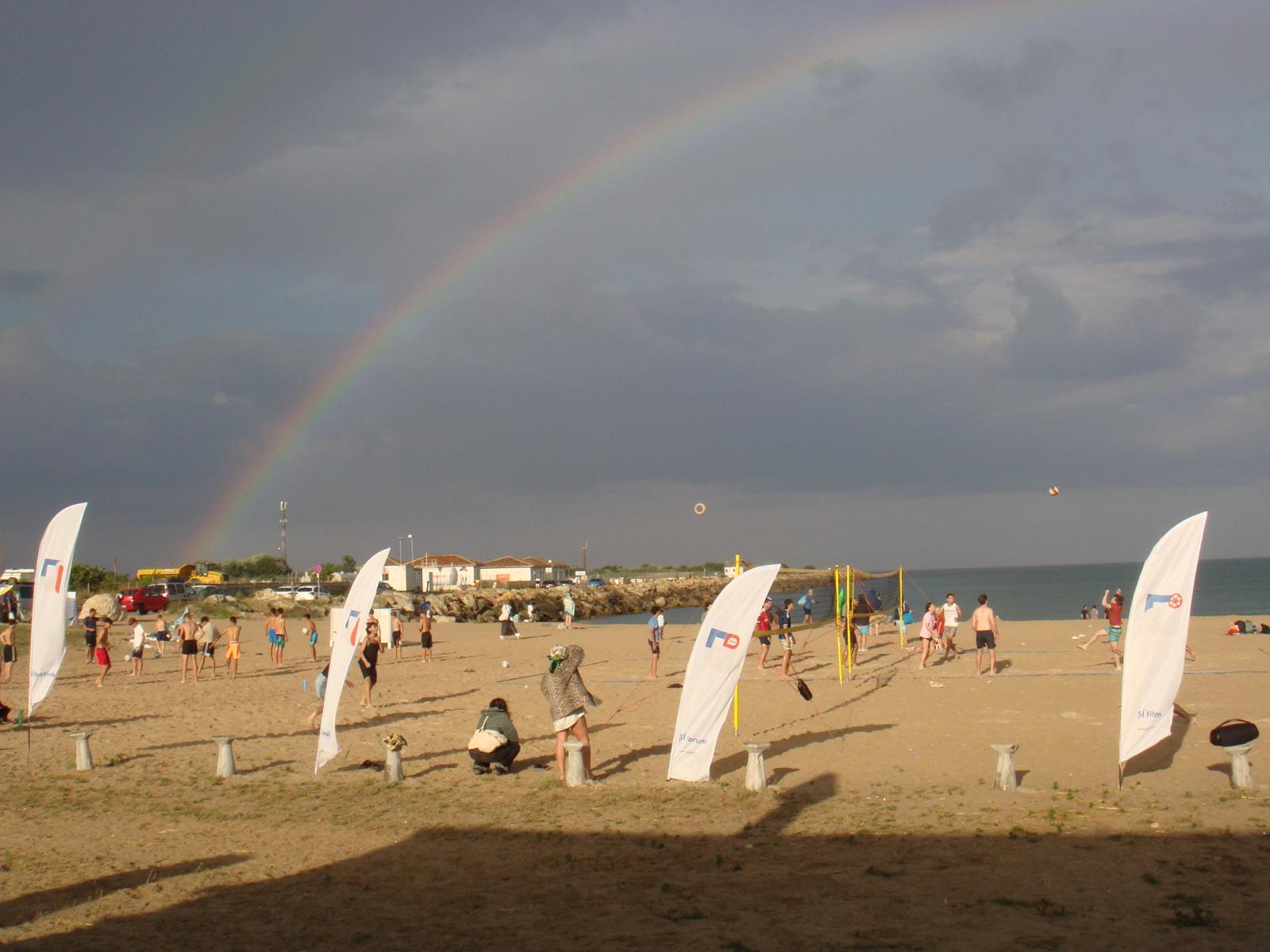
The kindergarten
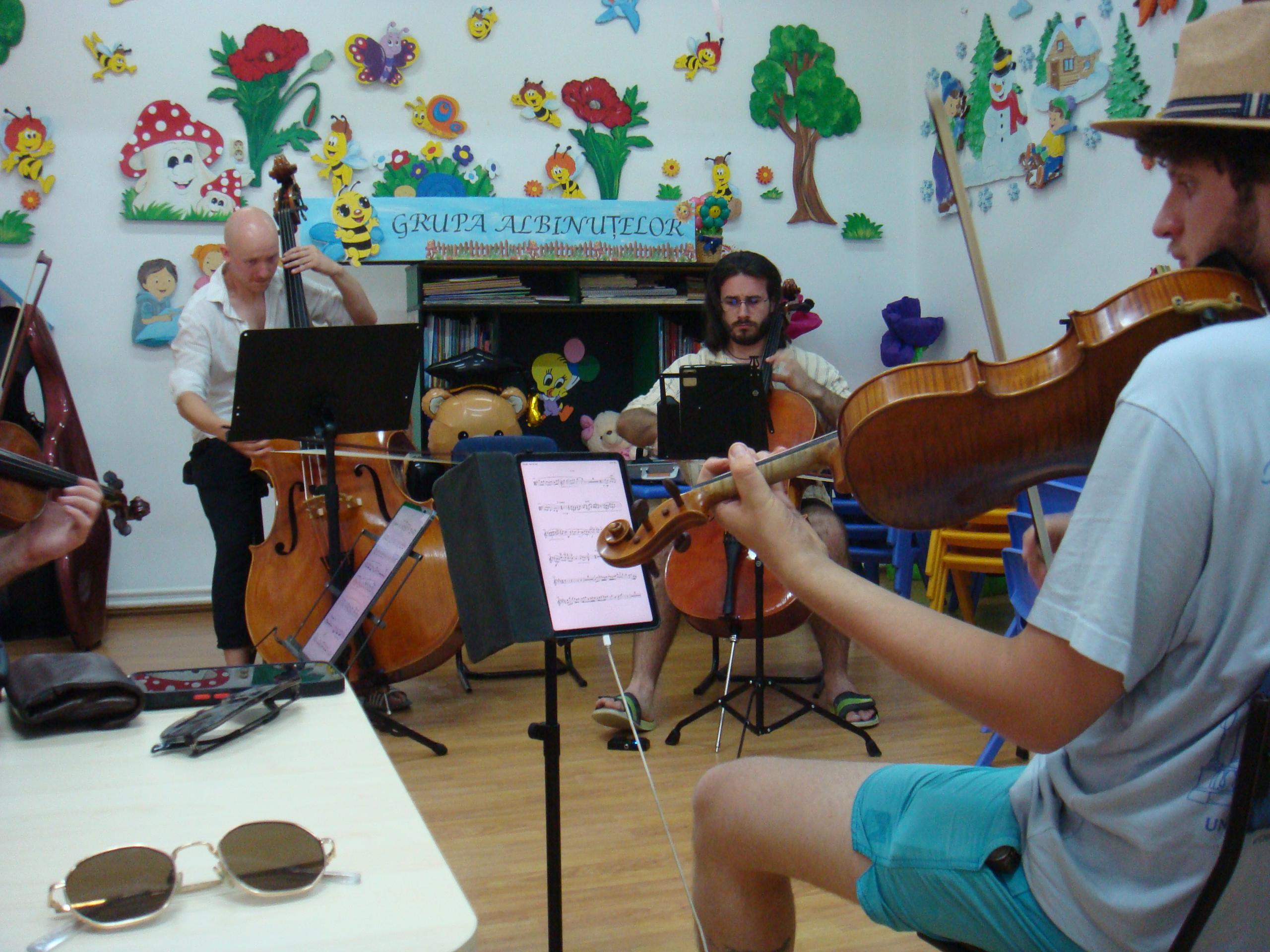
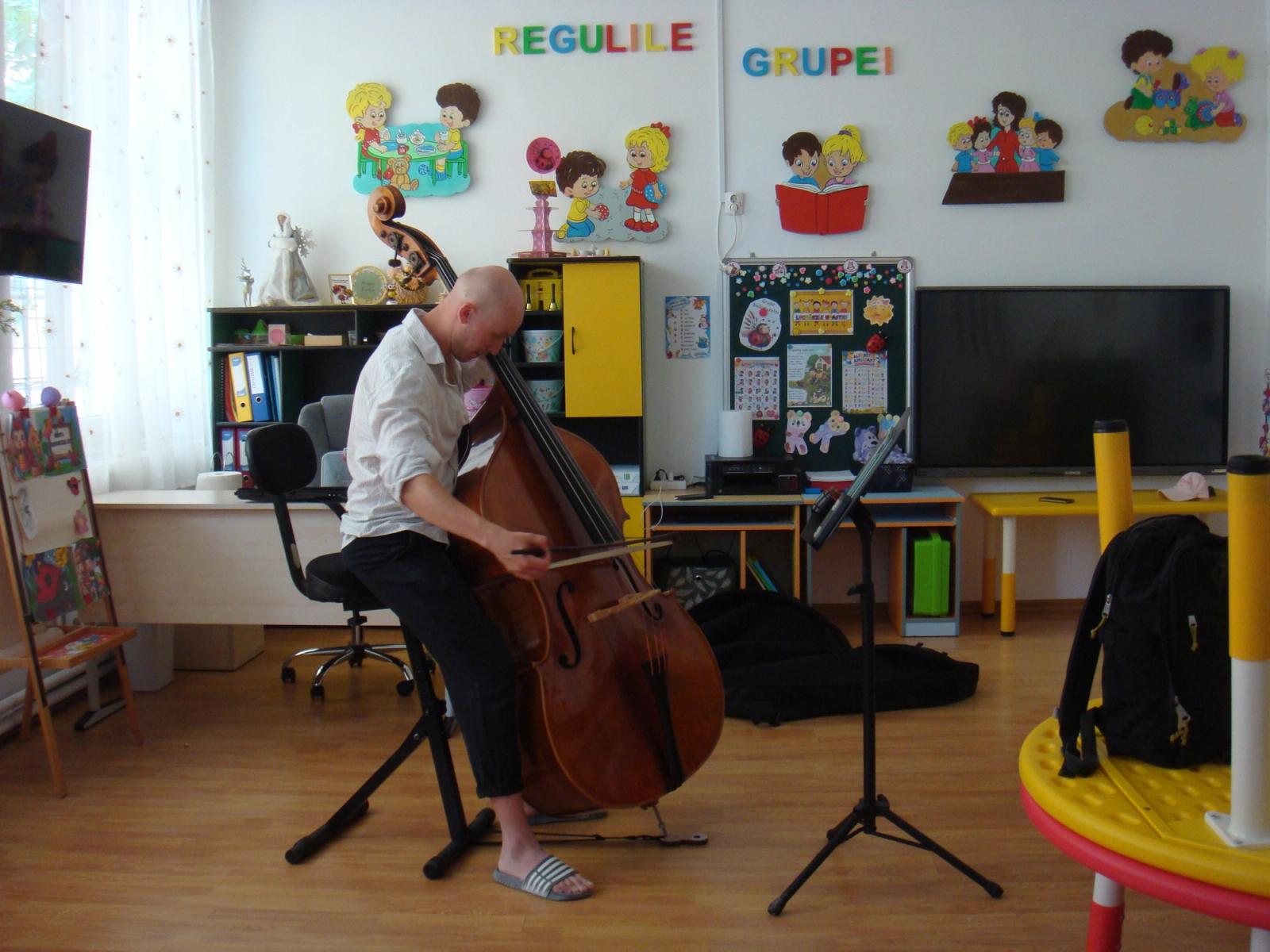
I met them as they were heading to the last rehearsal. The facilities: an entire kindergarten to work in, since it is summer holidays and nobody needs it; one classroom with accidentally superb wet acoustics; and all the privacy you could want.
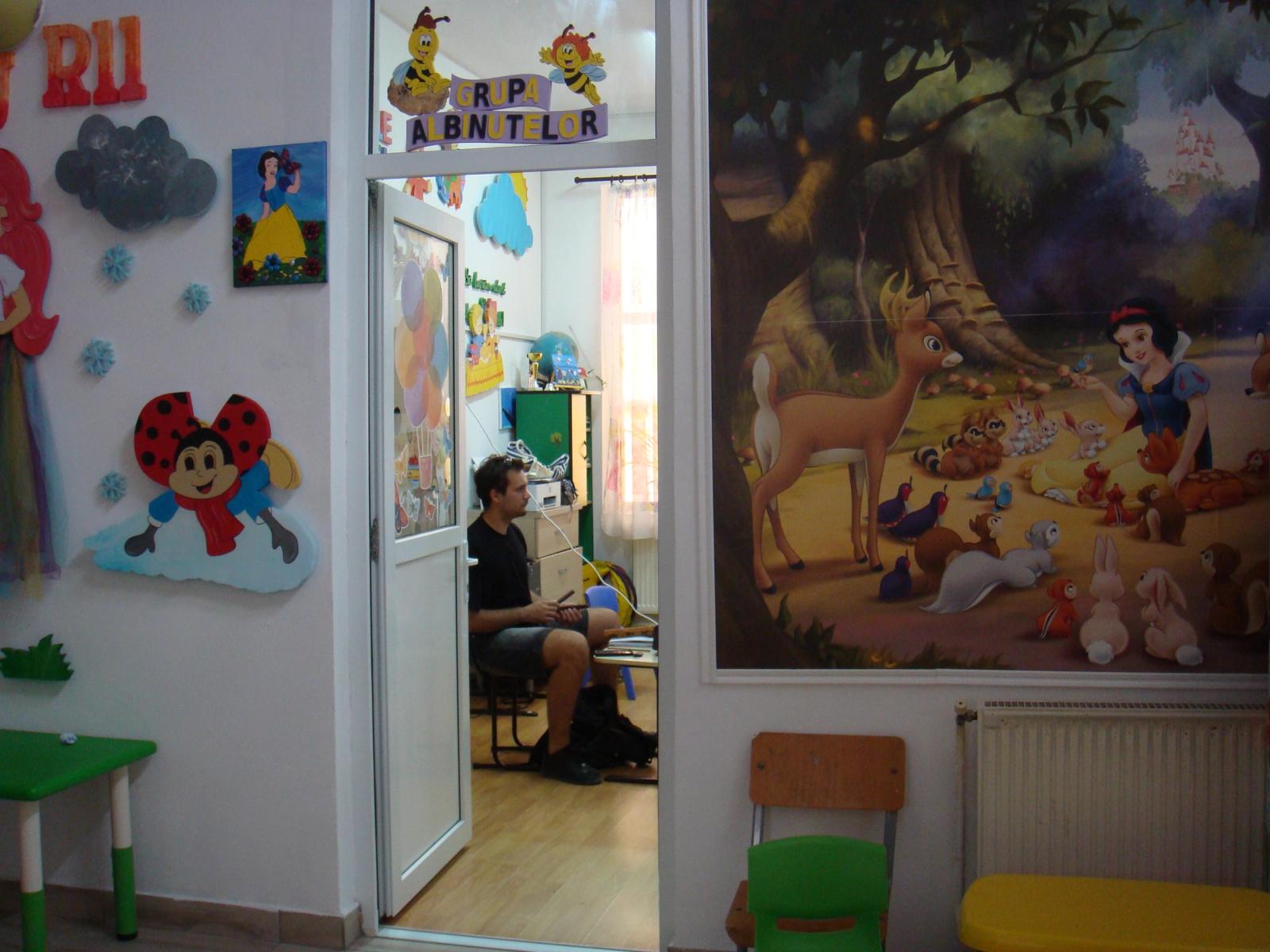
As they warmed up I could not stop turning over the irony. We grow up, decide we are mature, announce we have no time left for play. And there they were with their elegant instruments, surrounded by silly paintings and children's photographs, folded onto miniature chairs, grinning when a passage finally sat right and snapping at each other when someone drifted off the pace. We never stop playing. We just perform seriousness now, grown men, while the rules stay exactly what they were at five.
The catch
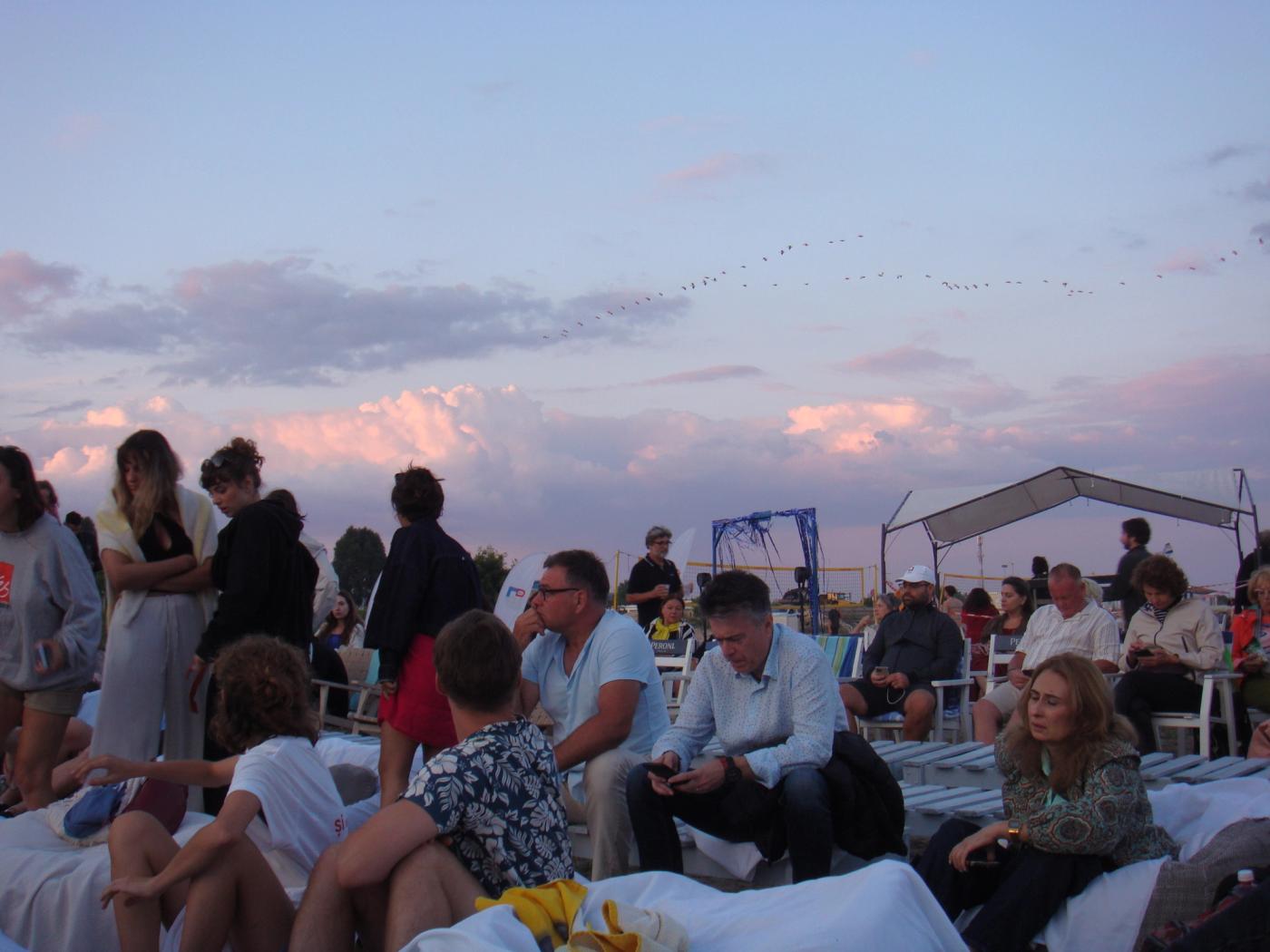
Night fell, the stars came out, and the festival gathered on the sand to watch the boys land a fish that would make Jeremy Wade jealous.
Three pieces planned, opening with the headliner. Iosif, as Bemol, set the tone: five friends, one boat, one fishing trip like all the others. Old friends messing around, joking, showing the audience exactly who they each are. The boys play through good weather, then curiosity, then confusion, excitement, victory, loss. The sea behind them got louder as it went. The whole beach held its breath until we were washed back ashore with them, and then it broke into applause.
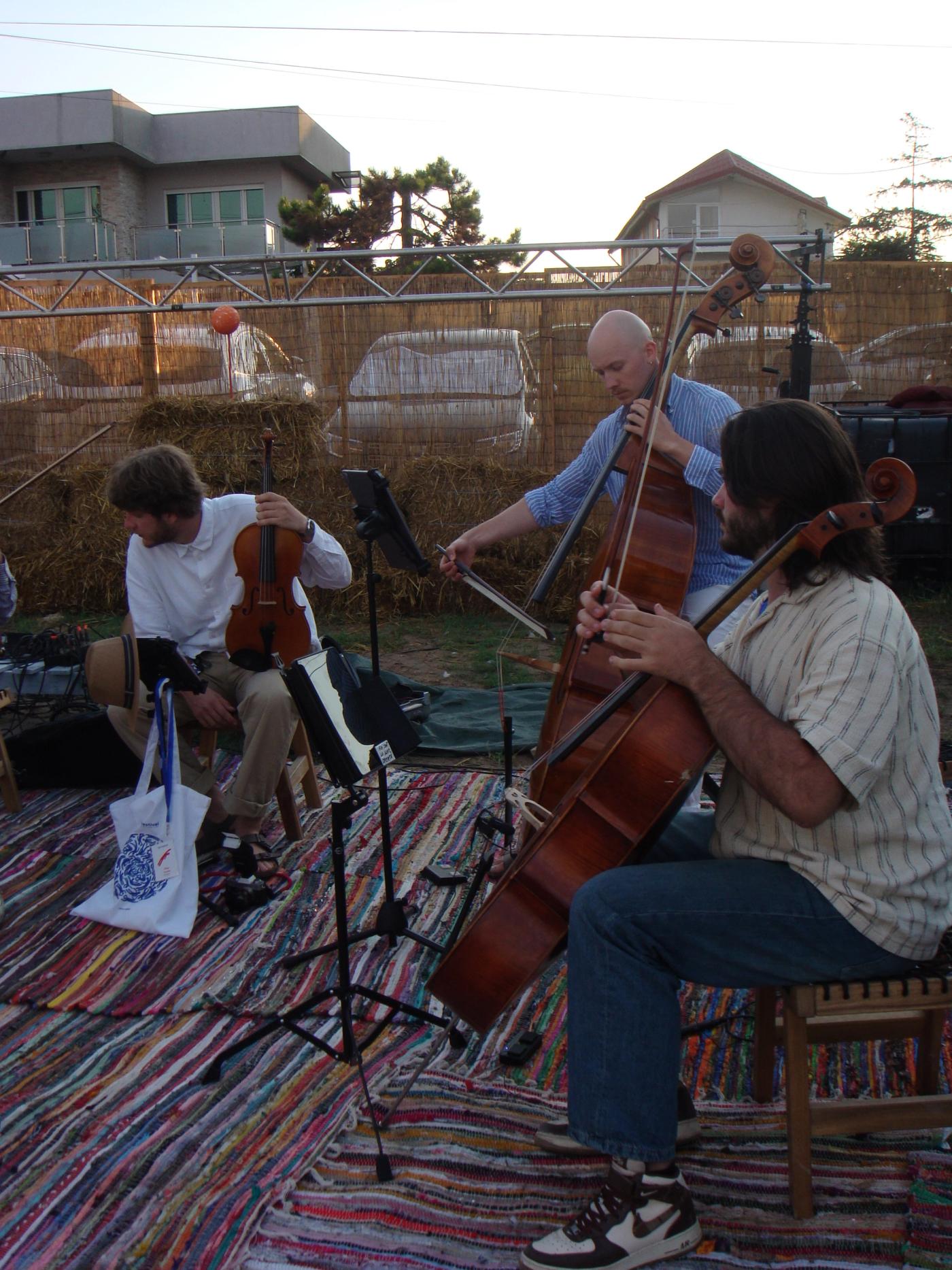
After a moment of letting themselves enjoy it, two more. First Impromptu à cinq, by the group's own pianist Fabiani Prcsina, folding Romanian traditional music into classical structure with jazz sitting in the seams: an unexpected mix, and a real display of how much these five know and how much they love music that is lying around in plain sight, possibly right next to you.
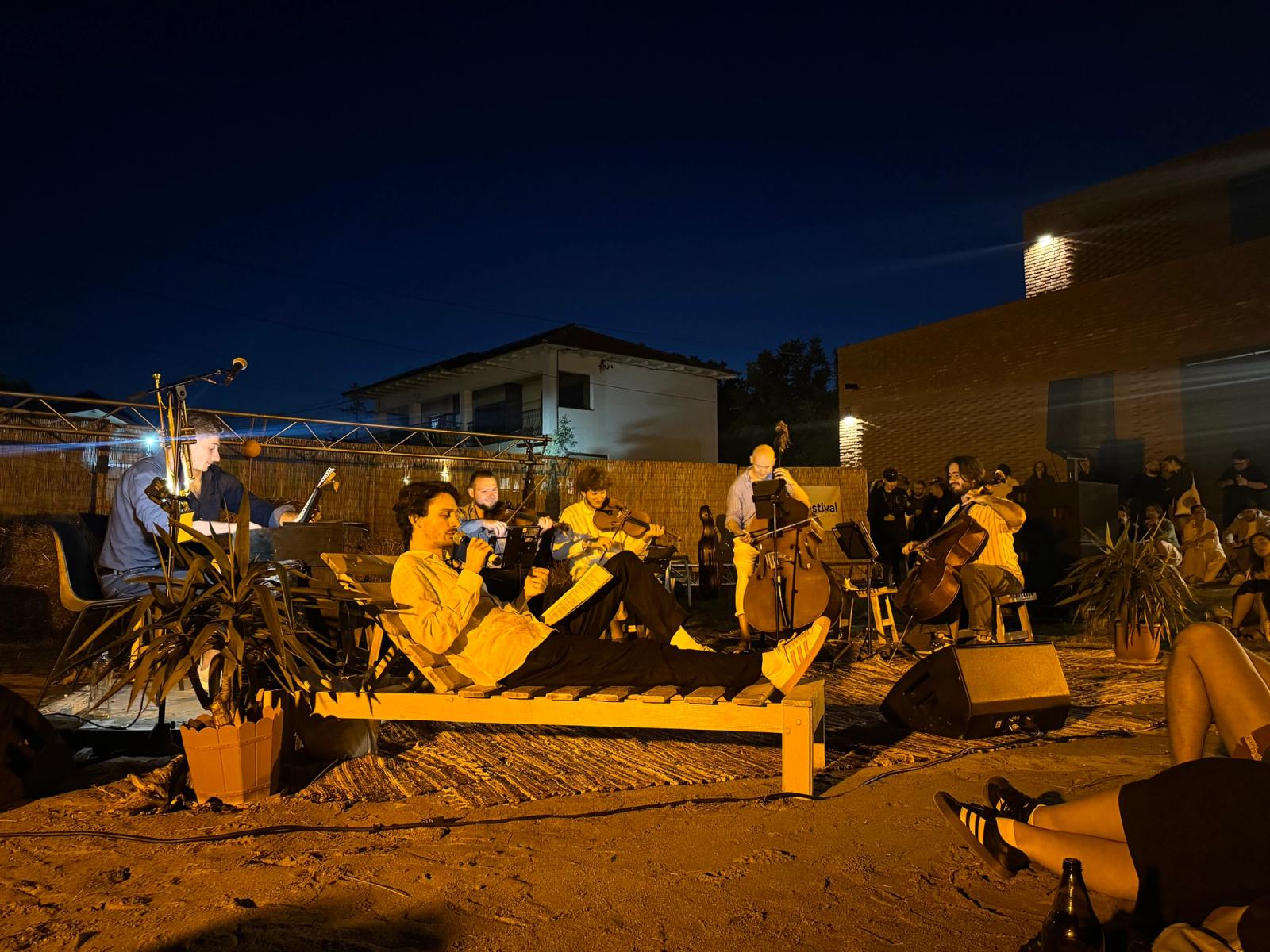
Then Arturo Márquez's Danzón No. 2, a Cuban ballroom form by way of Veracruz, running through a classical frame, which ended the night at full volume.
I don't know if the trout ever existed. I never saw it. Or I saw it, and I lied to you. Flatten me by a semitone, and you decide.
Nu știu dacă păstrăvul a existat vreodată. Eu nu l-am văzut. Sau l-am văzut, și v-am mințit. Coborâți-mă cu o jumătate de ton și hotărâți voi.
So. How exactly to catch a trout?
You gather your friends. You get a boat. You get magic fishing rods that turn into instruments. You find more friends. You hold a secret rehearsal that is not remotely secret, and you fill a flower shop with everyone who turned up to watch you practise. You take the boys to the seaside. You sunbathe, relax, laugh, live. You rehearse in a kindergarten and remember how to play. You gather an entire festival on a beach at sundown and show them the greatest catch in history. And you simply wait for the next round of fishing, wherever the waters might take you.
Simple, don't you think?
- WordsShepherd & Alberto Păduraru
- Published · TINCT Music
- Reading time9 min