(re)-defining classical music: a soirée with Nobuto's & Serpentine.iii's scores
Jeffery Macsim, a young pianist from Botoșani and rookie firefighter in London, gathers old friends in an exquisite vintage space in Bucharest for the type of soirée that can change your perception about classical music once and for all.
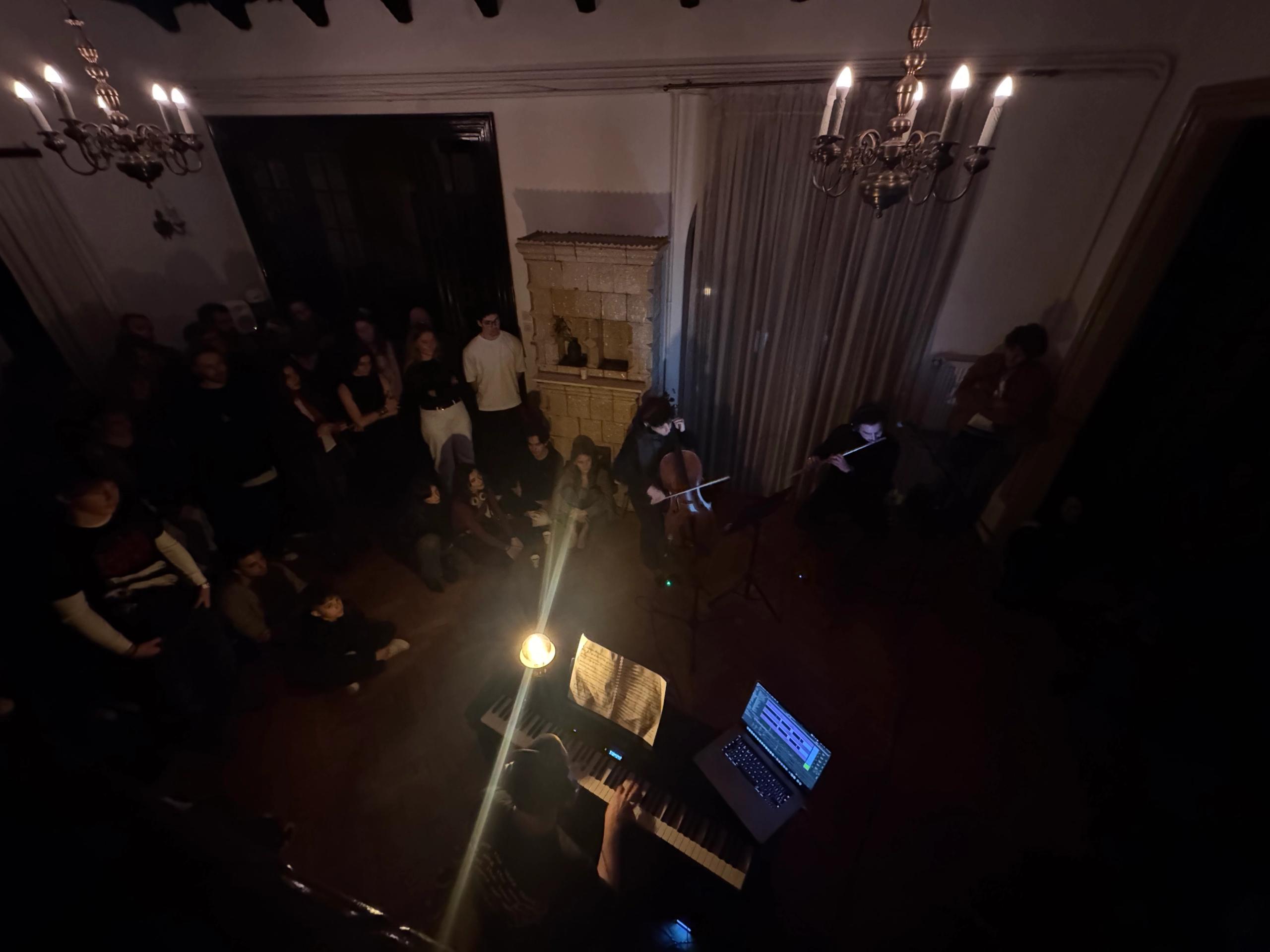
There is a single light bulb above the tiny piano. Not a spotlight, nor a rig. A bare incandescent bulb on a stand, the kind you'd find in someone's hallway. It catches eight desk bells lined up along the piano's lid, coloured differently, ressembling an alternative scale. The atmosphere is somewhat between a toy shop and a liturgical offering. The air is thick with a hazy, sweet-smelling fog (sandalwood mixed with tobacco or incense). If you closed your eyes, you could almost picture flickering oil lamps, or even paper lanterns, casting long, dancing shadows against the walls that carry a somber patina, a mixture between music and total silence.
Behind the tiny piano, a laptop screen glows with what looks like a frozen landscape: pale blues, ice textures, rather mythical, or ressembling the sea waves encountering the void. About fourty people sit on the herringbone parquet, legs crossed, backs against the walls. A cellist and a flutist are positioned to the right, half-visible. Nobody is talking, yet occasional whispers make it to the most sensitive of them ears. Could be the spirits of the wine. The chandeliers above are off. Dimly lit, the space is filled with deep crimsons, burnt oranges, and gold leaf, all muted by the dark, polished rosewood furniture.
This is Mostra Space, a cultural venue inside a 19th-century townhouse on Strada Căderea Bastiliei in Sector 1, Bucharest. The ceilings are high, the mouldings are ornate, there is a stone fireplace nobody has lit. The building carries the particular Romanian quality of old grandeur that hasn't been renovated into nothingness. You can feel the weight of the rooms. On a Thursday evening in April, it has been given over to an experimental classical recital that nobody outside a very specific radius knows is happening.
Jeff sits at the tiny piano. He studied at the Royal Academy of Music in London, first under Christopher Elton, now pursuing a PhD under Daniel-Ben Pienaar. Somewhere along the way he won the Lalla Meryem International Piano Competition in Rabat. He is also a firefighter in London, which is not the side job it might sound like. Jeff talks about both with the same seriousness, the same pull. Two lives that would exhaust most people, running in parallel, feeding each other in ways he doesn't always explain. He kept some of his students close and keeps on helping them practice. But not for contests or anything, rather for the fun of it.
Tonight he is playing works by Ben Nobuto, a British-Japanese composer, and by Serpentine.iii, alongside them. The music is not classical in the way that word usually promises. But Jeff has this rather unusual take that every composition that received a score of itself becomes classical music. Even if it implies the usage of Chance the Rapper vocal samples like: IGH!, or babies crying, or a variety of soundscapes that you would experience outside in the daylight of a crowded city: cabs, metro stations, industrial work, the rush and excitement produced or derived from crowds, generally speaking.
No familiar melodies, but rather common sounds, with no comfortable resolutions. It is textural, structural, sometimes abrasive, where the modified piano becomes a surface for preparation: Jeff, as if he reaches inside to dampen strings, strikes keys at thresholds between tone and noise, rings the desk bells at intervals that feel both random and inevitable, but were clearly anticipated by the score. The cellist draws long, spectral tones that hang in the room like weather. The flutist punctuates with breath-heavy phrases that blur the line between playing and simply exhaling.
There is a moment, maybe twenty minutes in, maybe forty. Time stops being useful. The three instruments and the laptop's projected visuals lock into something that isn't quite unison but feels like a shared nervous system. The room's temperature seems to change. Someone behind me shifts their weight on the parquet and then freezes, as if the sound of their own movement embarrassed them. I realise I am holding my breath, and I am not the only one. The woman to my left has her hand over her mouth. A man near the fireplace has closed his eyes and hasn't opened them in a minute. A mix of confusion, derangement, faux-understanding (at first, because you aknowledge the gazes that fly relentlessly throughout the room), acceptance (trying to understand less and let yourself feel more), allowance (gowing with the flow) and, finally, pleasant surprise. This is how Nobuto's music feels. And feels is the proper word, because no ammount of rationalisation could better explain this artist's approach (to non-musicians, at least).
Jeff and me are both from Botoșani. We became friends through a friend, as it usually happens. Then bonded over some Christmases in our hometown, beetroot soup, off the dome rap verses written in parking lots at 2 AM. But also went international. Showed up at Cannes Film Festival 76ème edition with a bunch of friends in a shared flat in Mandelieu de Napoule and had beaucoup de fun there sneaking to movies in our best tuxedos, while still working, of course. Once we pulled out of the hat in an instant another crazy idea: I went with my poetry debut (Cartea cu moace/The Book of Faces, we briefly translated it) to London for a reading at Spiritual Bar in Camden Town (read on mostly Jora's Joujoux pour ma dame and Scriabin's études at that time. Jeff's doing).
The shared origin, quite same raising, the same understanding of what it means to come from a place like that (Botoșani is, therefore, rather mythical) and end up somewhere else entirely. Watching him at this piano, in this lacquered room, is a strange kind of vertigo. He doesn't perform the way trained pianists are often trained to perform. There is no showmanship, no gestural excess. He sits. He plays. He disappears into the sound so completely that at some point you stop watching a person and start watching a process. But your friend is still there, though he's one with the keys and the bells now. As if the music is not coming from him. It is coming through him. The avatar at the keyboard is not the man from Botosani, and he is not the firefighter from London. He is someone that only exists in this room, for this hour, and will not exist again after. (Of course, a high-quality recording in a studio is proposed and therefore super-expected).
The recital doesn't so much end as thin out. The last notes from the piano dissolve into the cello's sustain, which dissolves into silence, which dissolves into the sound of Bucharest traffic filtering through the windows. For several seconds, nobody moves. The held breath releases across the room in a slow, almost involuntary exhale. Forty people remembering, at the same time, that breathing is a thing they need to do. Then someone claps, and the room comes back to itself, and it is over. Halftime over, at least.
Afterwards, people stand around in the hallway drinking wine from plastic cups poured by yours truly and chit-chatting. Jeff is there lighter, laughing, accepting compliments with the particular awkwardness of someone who was interested if the score was rather fun, or if the whole gathering was, God forbid, bourgeois. The desk bells are still on the piano. The light bulb is still on, flickering. We take a step out of Mostra Space, the hidden faux-shufang in the heart of the city.
Outside, Bucharest is doing what Bucharest always does on a Thursday night, entirely unaware that something happened in this house that forty people will carry home in their chests like a second heartbeat.
- WordsAlberto Păduraru
- Published — TINCT Music
- SeriesScene Report
- Reading time8 min
FAQ
- Who is Jeffery Macsim?
- A pianist from Botoșani who studied at the Royal Academy of Music in London under Christopher Elton and is now doing a PhD under Daniel-Ben Pienaar. He won the Lalla Meryem International Piano Competition in Rabat. He is also a working firefighter in London.
- What is Mostra Space?
- A cultural venue inside a 19th-century townhouse on Strada Căderea Bastiliei in Sector 1, Bucharest. High ceilings, ornate mouldings, an unlit stone fireplace. Old grandeur that has not been renovated into nothingness.
- What was performed at the soirée?
- Works by Ben Nobuto, a British-Japanese composer, and by Serpentine.iii. Textural and structural rather than melodic: prepared piano, eight tuned desk bells, cello, flute, and sampled city sound including Chance the Rapper vocals and traffic.
- Why call it classical music if it uses samples?
- That is Macsim's argument: any composition that has a score of itself is classical music. The instrumentation and the sample sources do not change what the notation makes it.